
Introduction: When a Fraction of a Micron Makes All the Difference
You’re producing the drive gears for a high-accuracy flow meter. The tooth-profile error tolerance is ±3 µm. Your current gear tool in the instruments and meter industry setup is consistently missing that spec — and every scrap part costs you money, time, and customer confidence.
Sound familiar? Gear cutting for instruments and meters sits at the intersection of two unforgiving demands: microscopic dimensional tolerances and high-mix, often low-volume production runs. A gear hob that works perfectly for automotive gearboxes may leave you with elevated noise, vibration, and inaccuracy the moment you scale down to module 0.5 precision gears.
In this guide, you’ll learn:
- Why instruments and meter gears demand a fundamentally different approach to gear tool selection
- How to match Nobeve’s product families — K-Series, G-Series, N-Series, W-Series, and P-Series — to your exact production scenario
- Practical setup tips that protect tight tolerances from the very first cut
- An honest comparison of carbide versus PM-HSS so you can make a data-driven decision
By the end, you’ll have a clear framework for choosing the right gear tool — and a direct path to verified case studies from Nobeve’s instruments and meter industry work.
What Makes Instruments and Meter Gears Uniquely Challenging?
Instrument-grade gears — think encoder wheels, flow-meter impellers, torque-sensor drives, and timing gears in analytical equipment — share several characteristics that separate them from typical industrial gears.
Miniature Module Sizes
Module sizes of 0.3 to 1.5 are common. At these scales, even the slightest hob runout or thermal growth translates directly to profile error. The chip load per tooth is tiny, so the gear tool must hold edge geometry with exceptional consistency across the full flute length.
Mixed Workpiece Materials
Instrument manufacturers frequently switch between stainless steel (316L, 17-4 PH), aluminium alloys, engineering plastics, and even titanium within a single production week. Each material imposes its own demands on cutting speed, lubrication, and edge sharpness — meaning a single gear hob specification rarely satisfies all requirements.
Low-Volume, High-Changeover Runs
Unlike automotive mass production where thousands of identical parts justify dedicated tooling, instrument shops often run 50–500 pieces per order. This places a premium on hobs that can be resharpened multiple times without losing profile accuracy, and on power skiving tools that reduce setup time dramatically.
Strict Noise and Vibration Limits
A flow meter or precision actuator that emits audible gear noise is a warranty claim waiting to happen. Achieving DIN AA or DIN AAA gear accuracy — the grades consistently delivered by Nobeve’s carbide and PM-HSS tooling — is the baseline expectation, not a premium option.
Choosing the Right Gear Tool: A Material-and-Machine Framework
Selecting the correct gear tool in the instruments and meter industry requires you to evaluate three factors simultaneously: workpiece hardness, machine rigidity, and batch volume. The following framework, drawn from Nobeve’s application data, maps those factors to specific product families.
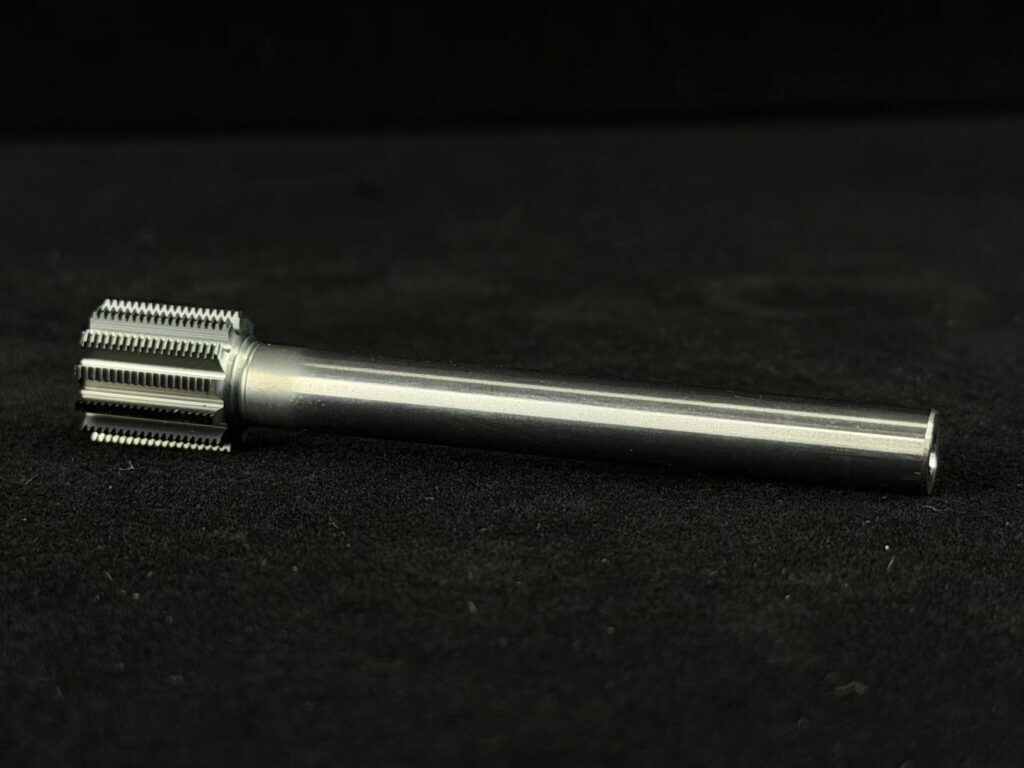
Scenario A — High-Speed Dry Cutting of Medium-Hard Stainless Gears
Profile: Module 0.5–2, workpiece hardness ≤ HRC 45, modern CNC gear hobber with spindle runout < 3 µm, batch size > 500 pieces.
Recommended tool:
The K-Series High-Speed Dry-Cutting Hob is the highest-throughput option for this scenario. Its solid Konrad Friedrichs carbide substrate paired with Balzers ALCRONA PRO or ALTENSA coating delivers cutting speeds of 150–300 m/min in dry or air-cooled conditions — ideal for clean-room-adjacent instrument manufacturing where cutting oil contamination is undesirable.
Key spec to remember: feed per revolution 0.5–0.8 mm/r at these speeds keeps chip thickness consistent across the full tooth depth, which is the primary driver of surface finish in miniature-module gears.
Scenario B — Hard-Gear Finishing of Hardened Instrument Shafts
Profile: Workpiece hardness HRC 45–62, post-heat-treat finishing, demanding profile accuracy.
This is where the G-Series Hard-Cutting Hob earns its place. Coated exclusively with Balzers ALTENSA — Oerlikon Balzers’ top-tier hard-film coating — the G-Series runs at 120–220 m/min in oil-cooled conditions and handles workpieces up to HRC 62. For the hardest stainless or tool-steel instrument gears, a two-pass strategy (rough + finish skiving) at HRC 56–62 is recommended to protect profile accuracy.
Scenario C — Job Shop / Legacy Machine / Soft Alloy Gears
Profile: Older manual or entry-level CNC gear hobber, mixed-material runs, workpiece hardness ≤ HRC 30.
The N-Series Low-Speed Wet-Cutting Hob is engineered specifically for this environment. Its sintered carbide grade is balanced for toughness rather than pure hardness, making it highly resistant to the micro-vibrations that afflict less rigid setups. Running at 60–150 m/min in oil cooling, it delivers DIN A and DIN AA accuracy at an ROI that makes sense for low-to-medium volume standard instrument gear production.
Scenario D — Power Skiving for Internal and Complex Instrument Gears
Power skiving has become the process of choice for internal ring gears, helical bores, and complex shaft gears common in encoder assemblies and servo actuators. Nobeve offers two skiving tool families optimised for the instruments and meter segment.
W-Series Solid Carbide Power Skiving Tool: Cutting speeds 120–300 m/min, workpiece hardness ≤ HRC 50, conical and cylindrical designs. The cylindrical variant’s low crossing-angle geometry is particularly effective for small-diameter internal gears in miniature actuators. However, this tool demands a rigid skiving machine — spindle vibration is the enemy of carbide skiving tools.
P-Series PM-HSS Power Skiving Tool: Manufactured from BÖHLER (Austria) powder-metallurgy high-speed steel with Balzers ALTENSA coating, the P-Series conical design excels when the workpiece is a tough, ductile alloy (≤ HRC 30) or when machine rigidity is limited. Its exceptional toughness makes edge chipping — the most common failure mode in carbide skiving under vibration — extremely rare.
�� Pro Tip: Many instrument manufacturers run the W-Series for their hardened external pinions and the P-Series for internal soft-alloy ring gears on the same machine, switching tools rather than machines. This dual-tool strategy maximises asset utilisation without sacrificing accuracy.
Carbide vs. PM-HSS: Head-to-Head Comparison for Instrument Gears
The following table summarises the key differentiators across Nobeve’s gear tool families when applied to instruments and meter applications.
| Criterion | Carbide (K/G/W-Series) | PM-HSS (P-Series) | Low-Speed Carbide (N-Series) |
| Cutting Speed | 150–300 m/min | 60–150 m/min | 60–150 m/min |
| Workpiece Hardness | Up to HRC 62 | ≤ HRC 30 | ≤ HRC 30 |
| Vibration Tolerance | Low (rigid machine req.) | High (excellent toughness) | High |
| Cooling Required | Dry or oil | Oil only | Oil only |
| Batch Volume | High-volume / mass prod. | Low-to-medium | Low-to-medium |
| Best for Instruments | Hard-material gears, skiving | Soft alloy / fragile parts | Legacy machines, job shops |
Data sourced from Nobeve internal application engineering records and publicly available cutting-data guidelines from gear machinery manufacturers.
Technical Deep Dive: Why Coating Chemistry Matters for Precision Instruments
Most gear tool manufacturers specify a coating. Far fewer explain why a particular coating was chosen for a specific application. Here’s what matters for instrument-grade gear cutting.
BALINIT® ALCRONA PRO — The All-Rounder
The AlCrN-based ALCRONA PRO coating from Oerlikon Balzers offers a hardness of approximately 3,200 HV and oxidation resistance up to ~1,100 °C. In K-Series and N-Series hobs, it provides the broad operating window needed for mixed-material instrument shops: stainless steel, aluminium, and engineering plastics all respond well.
BALINIT® ALTENSA — The Hard-Material Specialist
ALTENSA’s Al-Ti-Si-N architecture achieves hardness above 3,800 HV and is the preferred coating for G-Series hard-cutting and both skiving families. In the context of instrument gears made from 17-4 PH stainless or hardened bearing-grade steel, the extended hot-hardness retention of ALTENSA directly translates to longer tool life and fewer mid-run tool changes — both critical when a single batch of precision encoder gears must be completed without interruption.
According to Oerlikon Balzers’ published coating performance data, ALTENSA demonstrates up to 40% longer tool life compared to standard TiAlN coatings under high-heat dry-cutting conditions — a meaningful advantage when processing the hard stainless alloys prevalent in flow meters and analytical instruments.
Setup and Process Tips for Instrument-Grade Gear Hobbing
Even the best gear tool underperforms without the right process environment. These setup guidelines apply directly to instruments and meter production.
1. Minimise Arbor Runout
For module ≤ 1 gears, target arbor runout ≤ 2 µm. Use a hydraulic clamping arbor rather than a keyed arbor, and measure runout at the hob OD before every batch. At high cutting speeds, even 5 µm of runout generates a measurable lead error.
2. Match Feed to Module
A common mistake is using the same feed rate across different module sizes. For miniature-module instrument gears (m ≤ 1.0), stay at the lower end of the recommended feed range — 0.2–0.3 mm/r for skiving, 0.5–0.6 mm/r for hobbing — to maintain consistent chip geometry and avoid profile undercutting.
3. Cooling Protocol
K-Series hobs can run dry (air blast only), which is ideal for instrument shops that need contamination-free parts. For all oil-cooled applications (G, N, P, W-Series), use a high-pressure coolant system directed at the chip formation zone rather than flooding the full work area. This improves chip evacuation on small-module gears and reduces thermal shock on carbide substrates.
4. Regrinding Strategy
PM-HSS P-Series tools have a meaningful advantage here: they can typically be reground 5–7 times before scrapping, whereas solid carbide skiving tools are usually limited to 3–4 regrinds due to edge geometry constraints at small module sizes. For low-volume instrument runs, factoring regrind cost into total cost of ownership often favours the P-Series.
Nobeve in Action: Instruments and Meter Industry Case Studies
Theory is useful. Verified production data is better. Nobeve has documented multiple gear tool applications specifically within the instruments and meter sector, covering flow meters, encoder assemblies, and precision actuator gears.
You can explore these validated applications — including process parameters, achieved accuracy grades, and tool life data — on the Nobeve Instruments and Meter Industry page. If your application shares characteristics with a documented case, the recommended tool family and cutting parameters provide a proven starting point that eliminates weeks of trial-and-error optimisation.
Common Pitfalls and How to Avoid Them
Instrument manufacturers transitioning to higher-performance gear tools frequently encounter the same set of problems. Here are the most common — and their solutions.
Pitfall 1: Choosing Carbide for All Applications
Carbide is not always the premium choice. If your machine has limited spindle rigidity, or if your workpiece is a high-toughness alloy like 316L stainless in the annealed condition, carbide’s brittleness becomes a liability rather than an asset. The P-Series or N-Series will deliver superior edge life and surface finish in this scenario.
Pitfall 2: Ignoring Coating Refresh Cycles
Recoating a worn hob and returning it to service without checking profile accuracy is a recipe for scrap. After each regrind cycle, verify the hob profile against its original inspection certificate using a gear measuring machine. A hob with a correct edge but degraded profile is worse than a clearly worn tool — it produces gears that pass visual inspection but fail dimensional audit.
Pitfall 3: Over-engineering with Power Skiving When Hobbing Suffices
Power skiving reduces setup time and enables internal gear production that hobbing cannot achieve. But for simple external spur gears in the m 0.5–2 range at moderate volumes, a well-selected hob from the K or N-Series will outperform a skiving solution on total cost per part. Reserve the W-Series and P-Series skiving tools for applications where their geometric flexibility adds genuine value.
Frequently Asked Questions (FAQ)
Q1: What gear tool should I use for module 0.5 stainless steel encoder gears at HRC 28?
For soft stainless (≤ HRC 30) at module 0.5, the P-Series PM-HSS power skiving tool or the K-Series carbide hob are both strong candidates. If your machine is a modern CNC gear hobber with high spindle rigidity, start with the K-Series at 150–200 m/min dry. If you’re producing internal ring gears for the encoder, the P-Series conical skiving tool is the correct choice. Review Nobeve’s instruments and meter case study page for analogous applications with documented parameters.
Q2: Is powder-metallurgy HSS really better than standard HSS for instrument gear production?
Yes — meaningfully so. Standard HSS is produced by conventional casting, which creates carbide segregation that reduces edge consistency. BÖHLER PM-HSS, used in Nobeve’s P-Series, is manufactured via hot-isostatic pressing of atomised powder, which produces a homogeneous carbide distribution. The result is sharper, more repeatable edges, lower surface roughness on cut flanks, and 30–50% longer tool life in comparative tests on precision instrument gears. For a detailed breakdown, see Oerlikon Balzers’ technical coating documentation.
Q3: Can I use the same hob for both aluminium and stainless steel instrument gears?
In principle, a K-Series hob with ALCRONA PRO coating can cut both materials. However, aluminium’s tendency to build up on the cutting edge (BUE) is best mitigated with a very sharp edge geometry and high cutting speed — conditions the K-Series supports. For production shops running large volumes of aluminium instrument gears specifically, a dedicated hob with a polished flute and sharp (non-honed) edge will outperform a dual-purpose tool on surface finish and chip evacuation.
Q4: What accuracy grade can I realistically expect from Nobeve hobs on small-module gears?
All Nobeve carbide hob series (K, G, N) are manufactured to DIN AA or DIN AAA grade. The P-Series and W-Series skiving tools achieve DIN AA. In practice, achieving DIN AAA on the workpiece gear also depends on machine accuracy, arbor runout, and thermal stability. With a well-maintained, modern CNC gear hobber and arbor runout ≤ 2 µm, DIN AA workpiece accuracy is consistently achievable with the K and G-Series.
Q5: How do I evaluate whether to use hobbing or power skiving for a new instrument gear design?
Use hobbing (K/G/N-Series) when the gear is external, the module is ≥ 0.5, and machine setup time is manageable for the batch size. Switch to power skiving (W/P-Series) when the gear is internal, when the part design prevents hob overtravel (e.g., a shoulder or bore immediately adjacent to the gear), or when cycle-time reduction on a high-value part justifies the skiving machine investment. Nobeve’s application engineers can assist with the process decision — contact details are available on the About Us page.
Q6: Where can I find Nobeve’s instruments and meter industry applications?
Nobeve maintains a dedicated Instruments and Meter Industry page with application case studies, recommended tool families, and process parameters relevant to precision instrument gear production. It’s the fastest way to find a validated starting point for your specific application.
Conclusion: The Right Gear Tool Is a Competitive Advantage
In the instruments and meter industry, gear accuracy is not a differentiator — it’s a prerequisite. What separates leading instrument manufacturers from the rest is how consistently and cost-effectively they achieve that accuracy, batch after batch, across a diverse mix of materials and geometries.
The core principle is simple: match the gear tool to the three-way intersection of workpiece hardness, machine capability, and production volume. Use carbide (K/G-Series for hobbing, W-Series for skiving) where speed and hard materials demand it. Use PM-HSS (P-Series) or tough carbide (N-Series) where toughness, machine limitations, or ductile materials are the deciding factors.
Nobeve has built its product families around exactly this logic — each series engineered for a specific performance envelope rather than positioned as a generic compromise. That specificity is why Nobeve tools consistently achieve DIN AA and DIN AAA accuracy in the instruments and meter applications documented on our case study pages.
| ** Ready to select the right gear tool for your instruments and meter production? Visit nobeve-tool.com or contact Nobeve’s application engineering team for a personalised tool recommendation backed by your specific workpiece and machine data. |
→ Browse all Nobeve gear hob families at nobeve-tool.com
→ Contact Nobeve’s engineering team

