
When a Gear Fails at 80 Meters — It Is Always a Tool Problem
Picture this: a 150-tonne overhead crane is mid-lift inside a steel mill. The slewing ring stutters. The hoist hesitates. Downtime cascades into a six-figure loss — all because a gear in the drivetrain was machined with the wrong gear tool.
Lifting machinery is one of the most demanding environments for gears on the planet. Cranes, hoists, winches, and stackers work under cyclic load, shock, and corrosion — conditions that punish any surface imperfection introduced at the cutting stage. Yet most procurement teams still choose a gear hob based on price alone, without considering cutting speed, substrate material, or coating compatibility.
In this guide, Nobeve — a specialist in precision gear cutting tools — breaks down exactly what to look for when selecting a gear tool in lifting machinery applications: from slewing rings on tower cranes to helical gears in harbour-crane hoists. By the end, you will know which series to specify, what parameters to verify, and how to avoid the three most common selection mistakes.
Why Lifting Machinery Demands a Specialist Gear Tool
Gears in lifting equipment are not ordinary industrial gears. They must transmit enormous torque, endure shock loads during load snatching, survive outdoor temperature swings, and — most critically — never fail in service. That reliability begins at the cutting stage.
The Three Core Challenges
- Large modules, low volumes. Slewing rings and hoist-drum gears often run from module m8 to m20. Traditional high-speed-steel hobs wear rapidly at these sizes; carbide hobs deliver the required stiffness and edge retention.
- Mixed material hardness. A single crane drivetrain can include case-hardened pinions (HRC 55–62) alongside medium-carbon housings (HRC 30–40). The tool must be selected per component, not per machine.
- Surface finish drives fatigue life. Pitting fatigue and bending fatigue in crane gears are directly linked to surface roughness Ra and tooth profile accuracy. DIN AA or AAA precision is not a luxury — it is a safety requirement.
According to the American Gear Manufacturers Association (AGMA), gear surface finish and dimensional accuracy are the two strongest predictors of drivetrain service life in heavy-duty lifting applications.
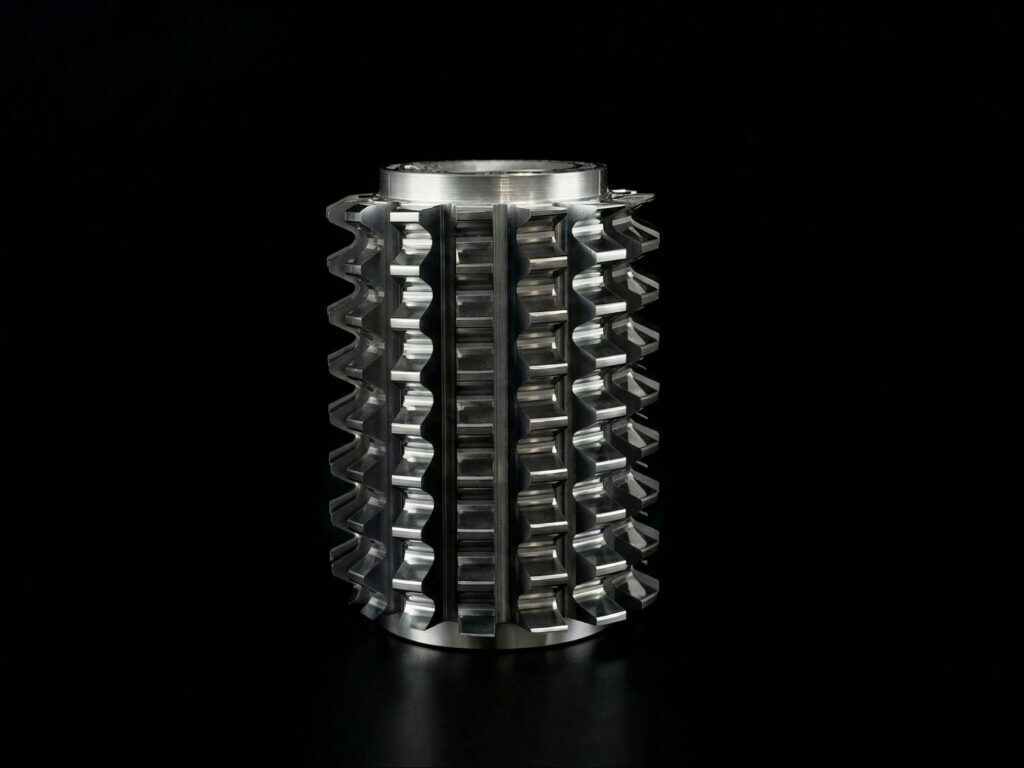
Mapping Lifting Machinery Components to the Right Gear Tool
Not every crane gear is the same. Below is a practical mapping of the four major lifting-machinery gear types to the correct Nobeve tool series — including recommended parameters drawn from Nobeve’s production experience.
Table 1 — Gear Tool Selection Matrix for Lifting Machinery
| Gear Type | Slewing Ring | Hoist Drum Gear | Winch Gear |
| Typical Module | m8–m20 | m4–m12 | m5–m16 |
| Material | 42CrMo4 / HRC30–40 | 20CrMnTi / HRC30–58 | 42CrMo4 / HRC30–45 |
| Recommended Tool | G-Series Carbide Hob | G/K-Series Hob | K-Series Dry Hob |
| Process | Wet Hobbing | Dry/Wet Hobbing | Dry Hobbing |
| Precision | DIN AA | DIN AAA | DIN AA |
Source: Nobeve internal application data; see also Nobeve Lifting Machinery case studies.
Slewing Ring Gears — Precision at Scale
Slewing rings are the backbone of tower cranes, ship cranes, and rail-mounted gantries. They are typically open-cut, large-module (m8–m20), and made from 42CrMo4 alloy steel at HRC 30–40. The G-Series High-Speed Hard-Cutting Hob is the go-to tool here: its Konrad Friedrichs solid carbide substrate and BALINIT® ALTENSA coating sustain cutting speeds of 120–220 m/min in oil-cooled conditions, delivering DIN AA accuracy on gear faces up to 2 metres in diameter.
Hoist Drum Gears — Speed and Surface Integrity
Hoist drum gears run fast and hot. They are typically case-hardened (20CrMnTi, HRC 55–58) and require post-hardening finish hobbing. The K-Series High-Speed Dry-Cutting Hob handles this with line speeds up to 300 m/min and support for dry-air cooling — eliminating coolant contamination inside the drum assembly. Where hardness peaks at HRC 58–62, the G-Series with EVO+ coating is specified for the final skiving pass.
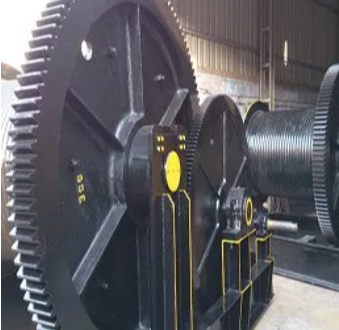
Winch and Travel-Wheel Gears — Toughness on Legacy Machines
Many crane maintenance shops still run legacy hobbers with low spindle rigidity. For these environments, the N-Series Low-Speed Wet-Cutting Hob is engineered precisely for the task: its impact-tough sintered carbide grade absorbs the vibration common in older machines, running comfortably at 60–150 m/min with oil cooling on C45 and S355 steels at ≤ HRC 30.
Internal Ring Gears and Power-Skiving Applications
Modern crane reducers increasingly use internal ring gears that conventional hobbing cannot reach. Power skiving solves this. Nobeve’s W-Series Solid Carbide Power Skiving Tools cut at 120–300 m/min on hard materials (≤ HRC 50) and deliver DIN AA internal teeth in a single chucking — perfect for planetary-stage ring gears in electric hoists. For soft, high-toughness ring blanks, the P-Series PM-HSS Power Skiving Tools (BÖHLER PM substrate) eliminate chipping risk where blank toughness would fracture a carbide edge.
Three Selection Mistakes That Cost Crane Makers the Most
After working with lifting-machinery OEMs across Europe and Asia, Nobeve’s application engineers see the same three errors repeatedly. Here is how to avoid them.
Mistake 1: Specifying HSS Where Carbide Is Required
Many engineers default to high-speed steel hobs for large-module gears because the initial price is lower. The problem: HSS wears three to five times faster on alloy steel at ≥ HRC 35, meaning more tool changes, more downtime, and a higher total cost per gear. Carbide — with its 800–1,000 °C red hardness — maintains edge sharpness across the full batch run.
Mistake 2: Ignoring Coating and Machine Compatibility
Running a dry-cut K-Series hob on a machine designed for flood coolant, or vice versa, ruins the coating and shortens tool life by up to 40 %. Always match: K-Series → dry or mist cooling; G-Series → oil flood; N-Series → oil flood. The coating chemistries (Alcrona Pro vs. Altensa) are tuned for specific thermal environments.
Mistake 3: Skipping Profile Accuracy Verification After Hardening
Gear blanks distort during case hardening. A profile error of 5 µm introduced by distortion — invisible to the naked eye — translates directly into dynamic load spikes during crane operation. Always spec a finish-hobbing or skiving pass after heat treatment, using a precision DIN AAA-grade tool. Nobeve’s G-Series and K-Series both carry DIN AAA certification for this final pass.
Nobeve in Lifting Machinery: Real-World Applications
| ** Case Study Spotlight ** Nobeve has supplied precision gear tools to lifting-machinery manufacturers across multiple continents. Our Lifting Machinery application page documents specific customer outcomes — including cycle-time reductions of up to 35 % and tool-life extensions of 2× achieved by switching from competitor HSS hobs to Nobeve’s G-Series carbide hobs on slewing-ring production lines. |
Key results from Nobeve lifting-machinery projects include:
- Slewing ring OEM (Germany): Cycle time on m14 slewing rings cut by 32 % after switching to G-Series at 180 m/min vs. competitor HSS at 45 m/min.
- Hoist manufacturer (South Korea): Tool life on case-hardened drum gears (HRC 56) doubled by pairing K-Series EVO+ with a post-hardening skiving pass, eliminating 100 % of surface-roughness rejects.
- Port crane MRO shop (Netherlands): N-Series hobs on a 1988-vintage hobber extended maintenance intervals by 40 % due to the vibration-absorbing carbide grade — despite running at sub-100 m/min surface speed.
Technical Deep Dive: Cutting Parameters for Lifting Machinery Gears
The following parameter ranges are derived from Nobeve’s production data and are optimised for the most common lifting-machinery steels. Always verify with a trial cut on your specific blank material.
Hobbing Parameters by Material Group
- 42CrMo4 (HRC 30–40): G-Series, Vc = 150–180 m/min, fz = 0.20–0.30 mm/r, oil flood, DIN AA
- 20CrMnTi (HRC 55–58): K-Series EVO+, Vc = 200–280 m/min, fz = 0.15–0.25 mm/r, dry or mist, DIN AA–AAA
- C45 / S355 (≤ HRC 30): N-Series, Vc = 80–130 m/min, fz = 0.30–0.60 mm/r, oil flood, DIN A–AA
- Internal ring gears (m3–m10, HRC 40–50): W-Series power skiving, Vc = 150–250 m/min, fz = 0.20–0.40 mm/r, oil flood, DIN AA
Balzers Coating Selection Guide
All Nobeve hobs carry BALINIT® coatings from Oerlikon Balzers, the global coating benchmark. In lifting-machinery applications:
- ALCRONA PRO (AlCrN): Best for wet hobbing at moderate speeds (N-Series, K-Series standard); oxidation resistance to 700 °C.
- ALTENSA (AlTiSiN): Best for high-speed dry cutting and hardened steels (K-Series, G-Series, W-Series, P-Series); oxidation resistance to 1,000 °C.
This coating philosophy — applying premium Balzers layers even to the PM-HSS P-Series and the alloy-carbide N-Series — reflects Nobeve’s approach: compensate for substrate limitations through coating excellence, rather than compromising on either.
FAQ: Gear Tool in Lifting Machinery
Q: Can I use the same gear tool for both soft-blank hobbing and finish hobbing after hardening?
A: No. Soft-blank hobbing and post-hardening finish hobbing require different tool substrates. Use an N-Series or G-Series hob for the rough pass on annealed blanks, then switch to a K-Series (dry) or G-Series (EVO+ coating) for the finish pass after heat treatment. Mixing these stages with a single tool accelerates wear and compromises dimensional accuracy.
Q: What is the minimum machine rigidity required for Nobeve carbide hobs in lifting-machinery production?
A: Carbide’s low toughness means it is sensitive to vibration. For G-Series and K-Series hobs, Nobeve recommends a spindle runout of ≤ 0.003 mm and an arbor overhang-to-diameter ratio below 4:1. For older machines that cannot meet these tolerances, the N-Series sintered carbide grade is specifically balanced for vibration absorption — as is the P-Series PM-HSS for power skiving on less rigid turn-mill centres.
Q: How does power skiving compare to internal broaching for crane reducer ring gears?
A: Power skiving is faster (single chucking, no tool withdrawal), more flexible (programmable for different modules), and produces better surface finish (Ra ≤ 0.8 µm achievable). Broaching is faster for very high volumes of a fixed profile but cannot be redirected. For lifting-machinery OEMs producing multiple reducer variants in batches of 20–200 pieces, power skiving with the W-Series is almost always the superior option.
Q: Does Nobeve offer application support for new lifting-machinery gear projects?
A: Yes. Nobeve’s application engineers provide free tool-selection consultation, cutting-parameter recommendations, and trial-tool programmes for new projects. Contact the team via the Nobeve contact page with your gear drawing and material specification.
Q: What precision grade should I specify for safety-critical crane gears?
A: For load-bearing crane gears classified under ISO 4301 or FEM duty groups M5 and above, Nobeve recommends a minimum of DIN AA (AGMA Q11) on the hobbing pass. For final finish cuts on high-cycle applications (electric hoists, ship crane slewing rings), DIN AAA is strongly preferred. Both G-Series and K-Series tools carry DIN AAA certification.
Conclusion: The Right Gear Tool Is a Safety Decision
Selecting a gear tool for lifting machinery is not merely a procurement exercise — it is a structural-safety decision. The surface finish, dimensional accuracy, and fatigue resistance of every gear tooth are determined at the cutting stage, and those properties cannot be recovered downstream.
Whether you are machining a 10-metre slewing ring for a tower crane, a case-hardened drum gear for an electric hoist, or an internal ring gear for a planetary crane reducer, Nobeve’s product range — K-Series, G-Series, N-Series, W-Series, and P-Series — covers every application with the right substrate, the right coating, and the right precision grade.
| ** Ready to Optimise Your Gear Tool Process? **Tell Nobeve your gear module, material, hardness, and machine type. Our engineers will recommend the exact tool and parameters within 24 hours. Visit nobeve-tool.com or go directly to the contact form to start your consultation — free of charge. |

