You have a non-standard gear to cut. You send an inquiry to a tool supplier. Then silence. Or worse: a vague quote arrives with no drawing, no inspection data, and a lead time of “8–12 weeks, TBD.” You have no idea what you’re buying until it shows up at the dock.
This lack of transparency is the #1 complaint manufacturing engineers report when sourcing custom gear cutting tools — particularly when working with overseas suppliers for the first time.
This article walks you through exactly how Nobeve handles every custom gear hob or power skiving tool order: from the moment you email your DXF file to the moment a DHL courier hands the package to your receiving department. No guesswork. No surprises.
| ** What You’ll Learn **: The 7-phase custom ordering process at Nobeve, with realistic timelines • What files and gear data you need to prepare before sending an inquiry • How the design drawing approval step protects you from costly mistakes • Quality inspection standards included with every order • How to get a free engineering evaluation for your application |
What ‘Made-to-Order’ Actually Means for Gear Tools
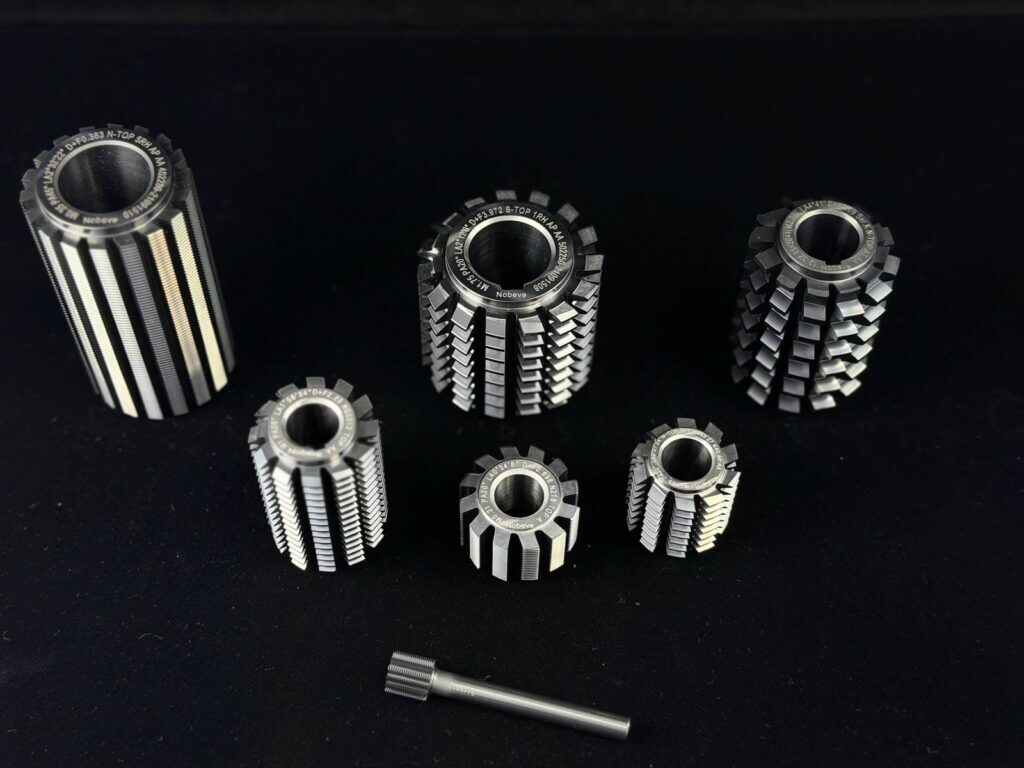
Made-to-order gear tools are not pulled off a warehouse shelf. Every dimension — outer diameter, bore size, helix angle, number of flutes, coating type — is engineered specifically for your gear geometry and your machine setup.
At Nobeve, this means your hob is ground from solid bar stock (German Konrad Friedrichs carbide for K and G series, Austrian BÖHLER PM-HSS for P series), heat-treated, and coated with Balzers BALINIT® ALTENSA or ALCRONA PRO — the same coatings used by Tier 1 automotive suppliers worldwide.
Because the tool is built from scratch, the process takes longer than standard stock tools — but the result is a cutting tool that fits your application precisely, rather than one you’re forcing to work.
When Do You Actually Need a Custom Gear Hob?
Most engineers reach the conclusion that a custom tool is necessary when one or more of these is true:
- Non-standard module or DP — your gear doesn’t match any catalog size.
- Special pressure angle — 14.5°, 22.5°, or a modified profile for noise reduction or load capacity.
- Unusual helix angle — high-helix helical gears outside standard catalog ranges.
- Tight accuracy class — DIN AA or AAA required, which standard tools can’t reliably deliver.
- Specific workpiece hardness — e.g., HRC50–62 hard-cutting requiring G-series geometry.
If your situation matches any of the above, browse Nobeve’s full product line to identify the right base series before starting your inquiry.
The 7-Phase Custom Gear Tool Process at Nobeve
Here is what happens from the moment your email arrives — step by step, with realistic timelines for a standard 3–4 week manufacturing cycle.
| Phase | What Happens | Timeline |
| 1. Inquiry | You email your DXF/DWG/STEP file + gear spec sheet | Day 1 |
| 2. Engineering Review | Nobeve engineers analyze your drawing and confirm feasibility | Day 1–2 |
| 3. Design Drawing Issued | Nobeve sends a detailed tool design drawing for your approval | Day 2–4 |
| 4. Customer Approval | You review and approve (or request revisions) | Day 3–5 |
| 5. Manufacturing | Grinding, heat treatment, coating (BALINIT® ALTENSA / ALCRONA PRO) | Week 1–3 |
| 6. Quality Inspection | Full dimensional inspection report generated (DIN AA standard) | Day 20–22 |
| 7. Shipping | Packed and dispatched via DHL/FedEx with tracking number | Day 22–28 |
The total window from inquiry to delivery is typically 22–28 calendar days for standard custom orders. Complex geometries (e.g., multi-start worm hobs, power skiving tools with tight profile tolerances) may run to 5–6 weeks. Rush pathways exist — contact us to discuss your deadline.

Phase 3 Deep Dive: Why the Design Drawing Step Matters
The design drawing approval is the step most buyers skip when working with opaque suppliers — and the step that prevents the most expensive mistakes.
Before Nobeve grinds a single flute, your engineering team receives a fully dimensioned 2D tool drawing showing:
- Cutting geometry: rake angle, relief angle, top land width
- Profile form including any protuberance for pre-grinding allowance
- Coating specification and base material grade
- Bore dimensions and keyway (if applicable)
- DIN accuracy class and inspection method
You sign off on this drawing before manufacturing begins. If there is any discrepancy between your gear spec and Nobeve’s proposed tool geometry, it is caught here — on paper — not after 3 weeks of grinding time.
What to Prepare Before You Send Your Inquiry
A well-prepared inquiry cuts days off your lead time. Nobeve’s engineering team can issue a design drawing in 24–48 hours when they receive complete data upfront. Here is the checklist:
Required Files
- DXF or DWG file — 2D gear drawing with full tolerance callouts
- STEP file (3D) — recommended for power skiving tools and complex profiles
- Gear data sheet — if your drawing does not fully specify the involute geometry, a separate data sheet listing the rack shift coefficient, span measurement, and tooth thickness is essential
Key Gear Parameters to Include
| Gear Parameter | Example / Notes |
| Module / Diametral Pitch (DP) | e.g., M3, M5, or 10 DP |
| Number of Teeth on Gear | e.g., 42 teeth |
| Pressure Angle | e.g., 20° standard, 14.5° legacy |
| Helix Angle | 0° (spur) or custom helix value |
| Workpiece Material & Hardness | e.g., 20CrMnTi, HRC28–32 |
| Required DIN Accuracy Class | e.g., DIN AA or DIN AAA |
| Hob OD / Bore Size | If you have an existing arbor |
| Quantity (batch size) | For pricing and lead time estimates |
Missing any of these parameters means Nobeve’s engineers need to ask follow-up questions — which adds 1–2 days to the front end of your timeline. The single biggest delay in custom hob orders is incomplete incoming data, not manufacturing capacity.
Selecting the Right Base Series for Your Custom Tool
Nobeve manufactures custom tools across five engineering-grade series. Matching your application to the correct series is the foundation of a successful custom order.
For Gear Hobbing Applications
- K-Series High-Speed Dry Cutting Hobs — Solid carbide (Konrad Friedrichs, Germany), Vc 150–300 m/min, dry or air-cooled, HRC ≤45° (EVO coating) or HRC 35–55° (AT coating). Best for high-volume automotive transmission lines with modern CNC hobbers.
- G-Series Hard Cutting Hobs — Solid carbide, BALINIT® ALTENSA coating, Vc 120–220 m/min, oil-cooled. Engineered for HRC 45–62° hard-skive applications. The go-to tool when you need to eliminate a separate hard-finishing operation.
- N-Series Low-Speed Soft Cutting Hobs — Sintered tungsten carbide balanced for toughness, BALINIT® ALCRONA PRO, Vc 60–150 m/min. Ideal for job shops running legacy or less-rigid gear hobbing machines, or for materials ≤HRC30°.
For Power Skiving Applications
- W-Series Solid Carbide Power Skiving Tools — Carbide substrate, BALINIT® ALTENSA, Vc 120–300 m/min. Superior for hard materials and small crossing-angle configurations. Machine spindle rigidity is critical — confirm with your machine builder before specifying.
- P-Series PM-HSS Power Skiving Tools — Austrian BÖHLER powder-metallurgy HSS, BALINIT® ALTENSA, Vc 60–150 m/min. The recommended choice for soft or high-toughness materials where edge chipping is a concern. Lower cutting speed, but significantly more forgiving.
If you are unsure which series fits your application, contact Nobeve’s engineering team with your workpiece material, hardness, and current machine model. They will recommend the appropriate base series before you commit to a drawing.
Quality Inspection: What Ships With Your Custom Tool
The gear manufacturing industry has a straightforward quality benchmark: DIN 3968 (now largely superseded by ISO 4468, though DIN terminology remains the trade standard). Nobeve’s custom tools are inspected against DIN AA and DIN AAA — the two highest accuracy grades — using calibrated profile measuring equipment.
Every custom tool order ships with:
- A full dimensional inspection report covering profile form error (ff), pitch accuracy (fp), and lead error (Fβ)
- Coating batch certification from Balzers / Oerlikon for the BALINIT® coating applied
- Material certificate for the bar stock (Konrad Friedrichs carbide or BÖHLER PM-HSS)
- A packing list and customs invoice pre-formatted for import clearance (HS code pre-filled for your convenience)
For aerospace and defense applications requiring PPAP or FAI documentation, contact Nobeve’s team before placing your order to discuss supplemental documentation options.
| ** Industry Reference **The ISO Technical Committee TC 60 (Gears) governs international gear accuracy standards. Gear hob accuracy standards are defined under ISO 4468:1982 (Hobs for involute gears — accuracy requirements). Nobeve’s inspection protocols align with these international benchmarks. |
Shipping & Logistics: From Our Factory to Your CNC Machine
Nobeve ships custom tools worldwide via DHL Express and FedEx International Priority. Standard delivery from dispatch to most major manufacturing hubs in North America, Europe, and Southeast Asia is 3–5 business days.
Packaging
Custom hobs ship in precision foam-lined wooden cases. Power skiving tools include individual tool sleeves to protect the cutting edge during transit. All tools are wrapped in VCI (volatile corrosion inhibitor) paper to prevent surface oxidation during shipping.
Lead Time Summary at a Glance
- Standard custom hob (K, G, N series): 3–4 weeks manufacturing + 3–5 days shipping
- Custom power skiving tool (W, P series): 4–5 weeks manufacturing + 3–5 days shipping
- Rush orders (capacity-dependent): Contact Nobeve for current capacity and expedite options
- Re-orders of previously made tools: 2–3 weeks (drawings already on file)
Frequently Asked Questions
How long does it take to get a custom gear hob from Nobeve?
The standard manufacturing cycle is 3–4 weeks from the date your design drawing is approved. Add 3–5 business days for international shipping. Your total door-to-door timeline is typically 4–5 weeks.
What file formats does Nobeve accept for custom inquiries?
Send your DXF, DWG, or STEP files by email along with a gear specification sheet. If you only have a sample physical gear and no drawing, contact Nobeve’s team — we can discuss reverse-measurement options.
Can Nobeve manufacture hobs for non-involute profiles?
Yes. Nobeve’s grinding capabilities support involute, circular arc, cycloid, and custom-form profiles. Share your full specification and the engineering team will assess feasibility and timeline.
What happens if the custom tool doesn’t perform as expected?
Nobeve’s design drawing approval step is specifically designed to prevent this scenario. If a tool delivered to the approved drawing fails to produce the expected gear accuracy, contact Nobeve immediately. The inspection report and material certs that ship with every tool provide the documentation needed to diagnose the root cause — whether it’s a tool issue, a machine setup issue, or a workpiece material variation.
Is there a minimum order quantity for custom tools?
No. Nobeve accepts single-piece custom orders. However, per-unit cost naturally decreases with volume. The engineering drawing and setup cost is amortized across the order quantity, so ordering 3–5 units of the same design is significantly more cost-efficient than 1.
Can I reorder the same custom tool later?
Yes. Nobeve retains all tool drawings on file. Re-orders of previously manufactured tools typically reduce lead time to 2–3 weeks, since the engineering phase has already been completed.
Summary: What Makes the Nobeve Custom Order Process Different
In a supply chain full of opaque lead times and vague quotes, Nobeve’s custom tool process is built around one principle: you should know exactly what you’re getting, and when you’re getting it, before manufacturing begins.
The process in brief:
- Submit your DXF/DWG/STEP file + gear specification
- Receive a formal tool design drawing for approval within 2–4 business days
- Approve the drawing — manufacturing starts
- 3–4 week manufacturing cycle with BALINIT® coating
- Full dimensional inspection report generated
- DHL or FedEx delivery with tracking
Whether you need a K-Series high-speed dry hob for a new automotive line, a G-Series hard-cutting hob to eliminate post-hardening finishing, an N-Series soft-cutting hob for a job shop setup, or a W-Series or P-Series power skiving tool for internal gear production — Nobeve has the engineering depth to deliver it to spec.
| ** Ready to Start Your Custom Tool Order? ** Email your DXF, DWG, or STEP files to Nobeve for a free engineering evaluation.Our engineers will review your gear spec and issue a tool design drawing within 2–4 business days — at no cost. ** Submit Your Inquiry at nobeve-tool.com/contact-us/ ** |
Learn more about Nobeve’s manufacturing capabilities and quality standards on the About Nobeve page. Nobeve Tool Co., Ltd. specializes in precision gear cutting tools for automotive, wind energy, aerospace, and industrial gearbox applications.Gear hob accuracy requirements referenced in this article follow international standards governed by ISO Technical Committee TC 60 (Gears), the international body responsible for gear accuracy and testing standards.

