
Introduction: When the Finish Tells You Something Is Wrong
You pull the part off the hobbing machine, run your finger across the tooth flank, and feel it immediately — that unmistakable washboard texture. Under the profilometer it confirms your suspicion: Ra is two or three times above spec, and the waviness pattern repeats with geometric precision. You are looking at gear hobbing chatter — and it is one of the most frustrating quality problems in gear manufacturing.
Chatter marks in gear hobbing are not random. They are a message. The repeating pattern is a clue: the machine, the fixture, the hob, or the cutting parameters are communicating that something in the system is out of balance. The good news is that once you know how to decode that message, you can fix the problem without buying a new machine.
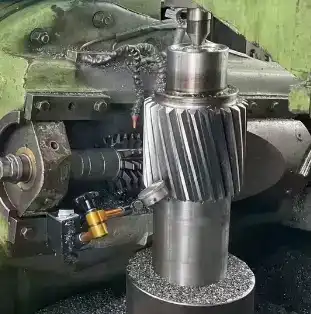
This guide walks manufacturing engineers and purchasing professionals through every root cause of gear hob vibration, from worn spindle bearings to mismatched chip-flute geometry — and provides a structured troubleshooting checklist so you can improve gear surface finish systematically. At Nobeve, we work with gear manufacturers on four continents, and this guide reflects the patterns we see most in the field.
What Causes Chatter Marks in Gear Hobbing?
Gear hobbing chatter is a form of forced or self-excited vibration that occurs when the dynamic cutting forces exceed the damping capacity of the machining system. It leaves periodic wave-like marks on tooth flanks that are visible to the eye and measurable as elevated Ra / Rz values. There are four primary source categories:
1. Machine Tool Rigidity and Spindle Condition
The hobbing machine’s structural loop — from spindle to workholding — must be stiff enough to resist the alternating cutting forces generated by each hob tooth engagement. When spindle bearing wear increases radial play beyond ~0.003 mm, or when the machine’s bed casting develops micro-cracks from years of use, every tooth engagement transfers a small vibration impulse into the next. These impulses accumulate into a repeating pattern: the classic chatter mark.
Practical check: place a dial indicator on the hob arbor and rotate it by hand. Runout exceeding 0.005 mm TIR at the arbor is a reliable indicator that the spindle or the arbor itself needs attention.
2. Workpiece Fixture and Clamping System
Even a perfectly serviced machine can produce chatter if the workpiece is not rigidly supported. Long, slender blanks clamped only at one end are particularly vulnerable. An expanding mandrel or hydraulic arbor is strongly preferred over a simple bore-and-keyway setup because it distributes clamping force uniformly around the bore, eliminating micro-rocking under cutting loads.
A quick diagnostic: machine the gear, then re-clamp and machine a second pass at zero depth. If the chatter marks disappear on the second pass, the root cause is fixturing, not the hob or the machine.
3. Cutting Parameters — Speed, Feed, and Depth of Cut
Running a carbide hob at a cutting speed that excites the natural frequency of the machine-hob-workpiece system will produce chatter even on a perfectly maintained machine. The relationship is not linear: small speed adjustments of 10–15% sometimes completely eliminate chatter by shifting the excitation frequency away from a system resonance. Similarly, excessive feed per revolution overloads chip gullets, causing intermittent tooth engagement and vibration.
For Nobeve’s K-Series dry-cutting carbide hobs, the recommended cutting speed range is 150–300 m/min. If you are experiencing chatter, start diagnostics at the lower end of the rated range and increase incrementally. For softer materials on conventional machines, the N-Series low-speed wet-cutting hobs are purpose-engineered for 60–150 m/min with enhanced toughness to absorb vibration.
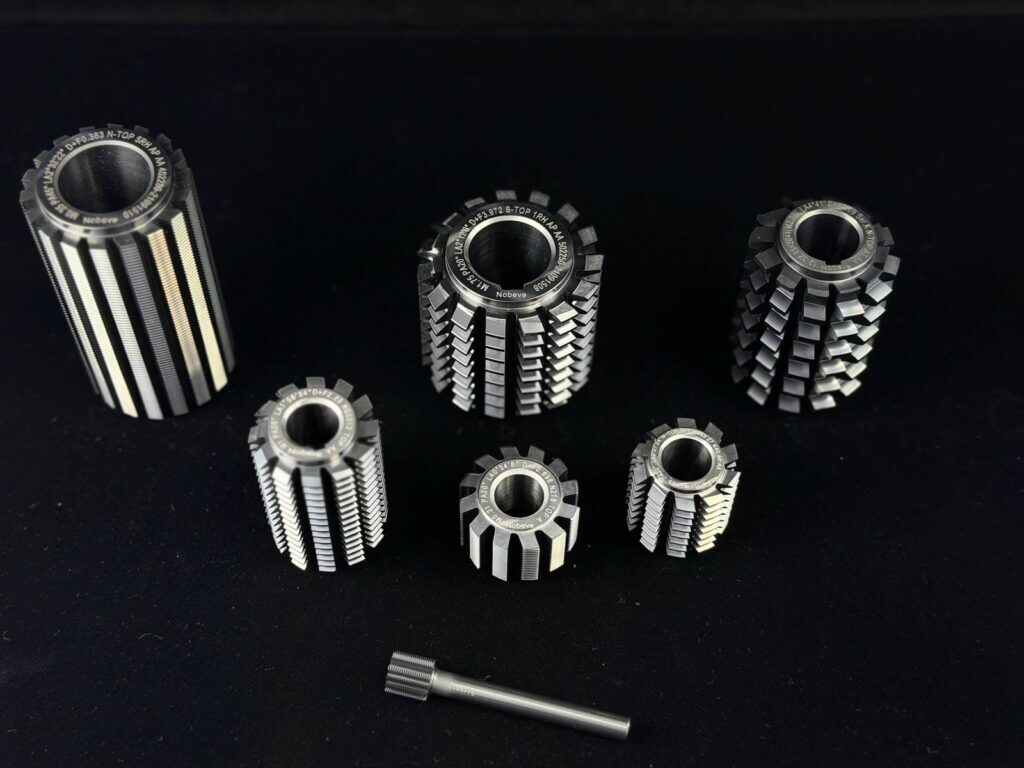
4. Hob Design Issues — Chip Flutes and Runout Error
The hob itself is frequently the overlooked variable. Two design-related causes stand out:
- Chip-flute geometry mismatch: If the hob’s flute helix angle does not match the workpiece helix angle within tolerance, the effective rake angle varies across the tooth width, creating uneven cutting forces. Uneven forces drive vibration.
- Hob runout (eccentricity): A hob with runout > 0.005 mm effectively has teeth that alternately take too-deep and too-shallow cuts. The resulting variation in chip thickness excites the system at the tooth-pass frequency — a primary driver of periodic chatter marks.
- Re-grind quality: Poorly re-ground hobs are a major but under-reported cause of chatter in job shops. Each re-grind that deviates from the original flute profile increases runout and rake-angle scatter.
Gear Hobbing Chatter: Full Troubleshooting Checklist
Work through this checklist in order. Each step eliminates one variable, allowing you to isolate the root cause without guesswork.
Troubleshooting Checklist — Chatter Marks in Gear Hobbing
| Root Cause | Symptoms | Recommended Fix |
| Machine spindle bearing wear | Consistent waviness across all teeth | Inspect & replace spindle bearings; verify runout < 0.003mm |
| Workpiece fixture looseness | Irregular pattern, worse at part edges | Retighten arbor; use hydraulic expanding mandrels |
| Hob runout error (>0.005mm) | Periodic tooth-to-tooth error | Re-grind hob; verify runout with dial indicator |
| Excessive cutting speed | Blue heat discoloration + chatter | Reduce Vc by 20–30%; check Nobeve K/G series guidelines |
| Insufficient coolant flow | Chatter worsens mid-cycle | Clean nozzles; increase coolant pressure to ≥ 4 bar |
| Chip flute clogging | Irregular surface, heavy burrs | Flush chip gullets; reduce feed to 0.3–0.5 mm/rev |
| Pro Tip: Always address machine and fixture rigidity before adjusting cutting parameters. Compensating for a loose setup with lower speeds is a temporary fix that reduces productivity. Fix the system first, then optimize the process. |
How Hob Selection Directly Affects Vibration Resistance
Many engineers treat hob selection as a procurement decision, not an engineering decision. This is a costly misconception. The hob’s substrate material, coating, and geometry all directly influence its tendency to generate or absorb vibration.
Carbide Hobs: High Rigidity Required
Solid carbide hobs — such as Nobeve’s K-Series (dry cutting, up to 300 m/min) and G-Series (hard cutting, HRC 45–62) — deliver maximum productivity and tool life on hard materials. However, carbide’s high modulus of elasticity (approximately three times that of steel) means it transmits rather than absorbs vibration energy. On a machine with any existing play in the spindle or fixture, this amplifies chatter rather than suppressing it. Carbide hobs require:
- Machine spindle runout ≤ 0.003 mm
- Hob arbor clamping with hydraulic or precision collet systems
- Coolant pressure ≥ 4 bar for adequate chip flushing
- Stable workpiece clamping — zero fixture rocking under dynamic load
PM-HSS Hobs: Built-in Vibration Tolerance
Powder metallurgy high-speed steel (PM-HSS), as used in Nobeve’s P-Series power skiving tools, has a fundamentally different response to vibration. The fine, uniform carbide grain structure of PM-HSS (sourced from BÖHLER, Austria) provides significantly higher fracture toughness than conventional HSS or solid carbide. In practical terms, a PM-HSS hob on a slightly worn machine will absorb micro-vibrations rather than amplifying them — translating into cleaner tooth flanks on tough or ductile workpiece materials.
The tradeoff: PM-HSS is limited to cutting speeds of 60–150 m/min and requires oil-flood cooling, making it unsuitable for high-throughput dry-cutting lines. For precision power skiving of internal gears on softer blanks (≤ HRC 30), the P-Series is often the lowest-chatter solution available.
Coating Technology: The Finish Line
Even the best substrate underperforms without the right coating. Nobeve applies BALINIT® ALTENSA (from Oerlikon Balzers) to both the G-Series and W-Series, and BALINIT® ALCRONA PRO to K-Series and N-Series hobs. These PVD coatings reduce cutting-edge friction and built-up edge formation — two contributors to intermittent force spikes that drive chatter. Think of the coating as the last line of defense: it doesn’t fix a loose spindle, but it ensures the hob isn’t adding to the vibration problem.
For a technical deep-dive on Nobeve’s full product range, visit nobeve-tool.com or browse the W-Series carbide power skiving tools for high-speed internal gear applications.
Machine and Process Setup: The Often-Ignored Foundation
Spindle Speed Selection — Avoiding Resonance Zones
Every hobbing machine has natural resonance frequencies in its structure. Running the spindle at a speed that excites these frequencies produces forced resonance — the most severe form of chatter. Modern CNC hobbers allow spindle speed sweeps where the operator increases speed in 5 rpm increments while monitoring vibration with an accelerometer. Documenting “bad speed zones” for a given machine and avoiding them in process parameter sheets is a straightforward, zero-cost improvement.
According to the American Gear Manufacturers Association (AGMA), surface finish consistency is one of the top three quality attributes measured in gear acceptance testing. AGMA standards provide surface roughness benchmarks by gear quality class — a useful external reference when specifying machining targets.
Coolant Delivery and Chip Evacuation
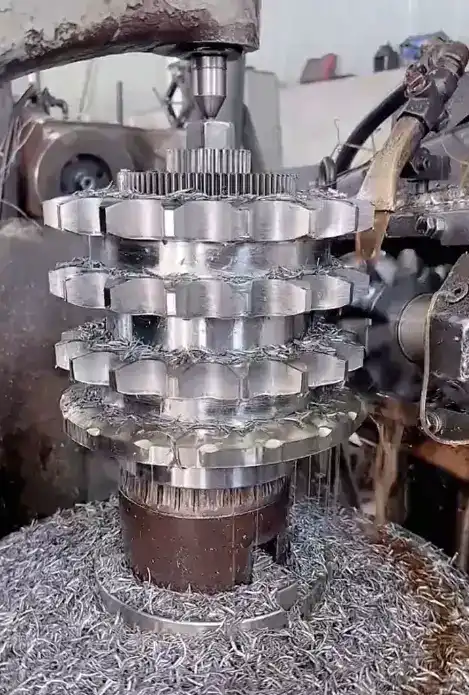
Insufficient coolant flow is a surprisingly common secondary cause of chatter. When chips are not flushed from the cutting zone, they re-enter the chip gullet and create intermittent overloads. Each overload produces a micro-deflection of the hob arbor — and at hobbing speeds, these micro-deflections occur hundreds of times per second, generating audible and measurable chatter.
Minimum recommended coolant parameters for wet hobbing:
- Flow rate: ≥ 20 L/min directed at the cutting zone
- Pressure: ≥ 4 bar at the nozzle exit
- Oil viscosity: ISO VG 32–46 gear-cutting oil for HSS/carbide compatibility
- Nozzle position: aimed at chip gullet entry, not hob OD
Gear Blank Preparation and Material Consistency
Hard spots, inclusions, or inconsistent hardness in the gear blank create sudden variations in cutting resistance. On a soft blank (≤ HRC 30), this is rarely an issue. But on pre-hardened billets or flame-hardened blanks with case-depth variation, these hardness gradients generate exactly the kind of intermittent force variation that drives chatter.
Request a hardness profile from your material supplier and verify that the blank hardness variation is ≤ ±2 HRC across the tooth zone. This one step eliminates a class of chatter problems that cannot be fixed by adjusting machine parameters.
Advanced Topics: When Standard Fixes Don’t Work
Dynamic Balancing of the Hob Assembly
At cutting speeds above 200 m/min, even a small mass imbalance in the hob assembly — hob, arbor, and driving key — generates centrifugal forces that excite the spindle at rotational frequency. For high-speed carbide hobbing, G6.3 or better dynamic balance (per ISO 1940-1) of the complete hob assembly is recommended. Most hob manufacturers, including Nobeve, can supply pre-balanced assemblies on request.
Anti-Vibration Hob Arbors
Specialized hob arbors with internal damping cartridges (similar to anti-vibration boring bars in turning) are available from several tooling suppliers. They are most effective for slender workpieces with L/D > 4 where the workpiece itself is the flexible element in the system. If conventional fixture improvements have been exhausted, this is a viable next step.
Structural Modification and Reinforcement
Legacy machine tools can often be improved through epoxy granite filling of hollow casting sections, addition of constrained-layer damping panels, or bolt-on mass dampers tuned to the machine’s dominant resonance. These are capital investments, but considerably less expensive than machine replacement and often restore a machine to near-new vibration performance.
Frequently Asked Questions
Q1: Can I fix chatter marks without buying a new machine?
A: Yes — in many cases. Start by checking fixture rigidity, hob runout, and cutting parameters before assuming the machine is at fault. Switching to a hob with optimized chip-flute geometry (such as Nobeve’s K-Series or N-Series) often resolves the issue without capital expenditure.
Q2: What surface roughness (Ra) should I target for automotive gears?
A: For most automotive transmission gears, Ra ≤ 0.8 µm after hobbing is typical before any grinding or honing step. If you are finish-hobbing to final tolerance (no subsequent grinding), aim for Ra ≤ 0.4 µm, which requires a rigid setup, correct cutting parameters, and a premium hob with BALINIT® ALTENSA coating.
Q3: How do I know if my hob’s chip flutes are the problem?
A: Inspect the flute land: if chips are welding onto the rake face or the flute shows signs of loading, clogging is likely. Also check the helix angle suitability — a flute helix that doesn’t match your workpiece lead angle wastes chip evacuation efficiency and introduces vibration.
Q4: Carbide vs. HSS hob — which is less prone to chatter?
A: PM-HSS (powder metallurgy high-speed steel, as used in Nobeve’s P-Series) is inherently more chatter-resistant on soft or tough materials because its higher toughness absorbs micro-vibrations. Solid carbide hobs (K/G/W-Series) cut faster and last longer on hard materials, but require a stiffer machine setup to avoid chatter from carbide’s lower fracture toughness.
Q5: My parameters look correct, but chatter persists — what next?
A: Request an engineering evaluation. Share your machine model, fixture drawing, workpiece material spec, and a photo of the chatter pattern with Nobeve’s technical team. Email your DXF/STEP files to receive a free tooling recommendation tailored to your setup.
Summary and Next Steps
Gear hobbing chatter is a solvable engineering problem — but only if you approach it systematically. The key insight is that chatter is almost always a system problem, not a single-component problem. Machine rigidity, fixture design, cutting parameters, and hob geometry all interact. Change one variable at a time, document the result, and work through the checklist until the root cause is isolated.
The right hob makes a measurable difference. Nobeve’s product line is engineered specifically to address the full spectrum of gear hobbing environments — from the K-Series for high-speed dry carbide cutting on modern CNC hobbers, to the N-Series for vibration-tolerant wet cutting on legacy equipment, to the P-Series PM-HSS power skiving tools for maximum toughness on ductile materials. Learn more about Nobeve’s engineering approach on the About Us page.
| ** Free Engineering Evaluation **— Send Us Your Drawings Still seeing chatter marks after working through this checklist? Email your DXF, DWG, or STEP files to Nobeve’s engineering team. We will review your workpiece geometry, machine capability, and current tooling and provide a no-cost tooling recommendation with specific cutting parameters. Visit nobeve-tool.com/contact-us/ to submit your inquiry — most evaluations are returned within 48 hours. |

