
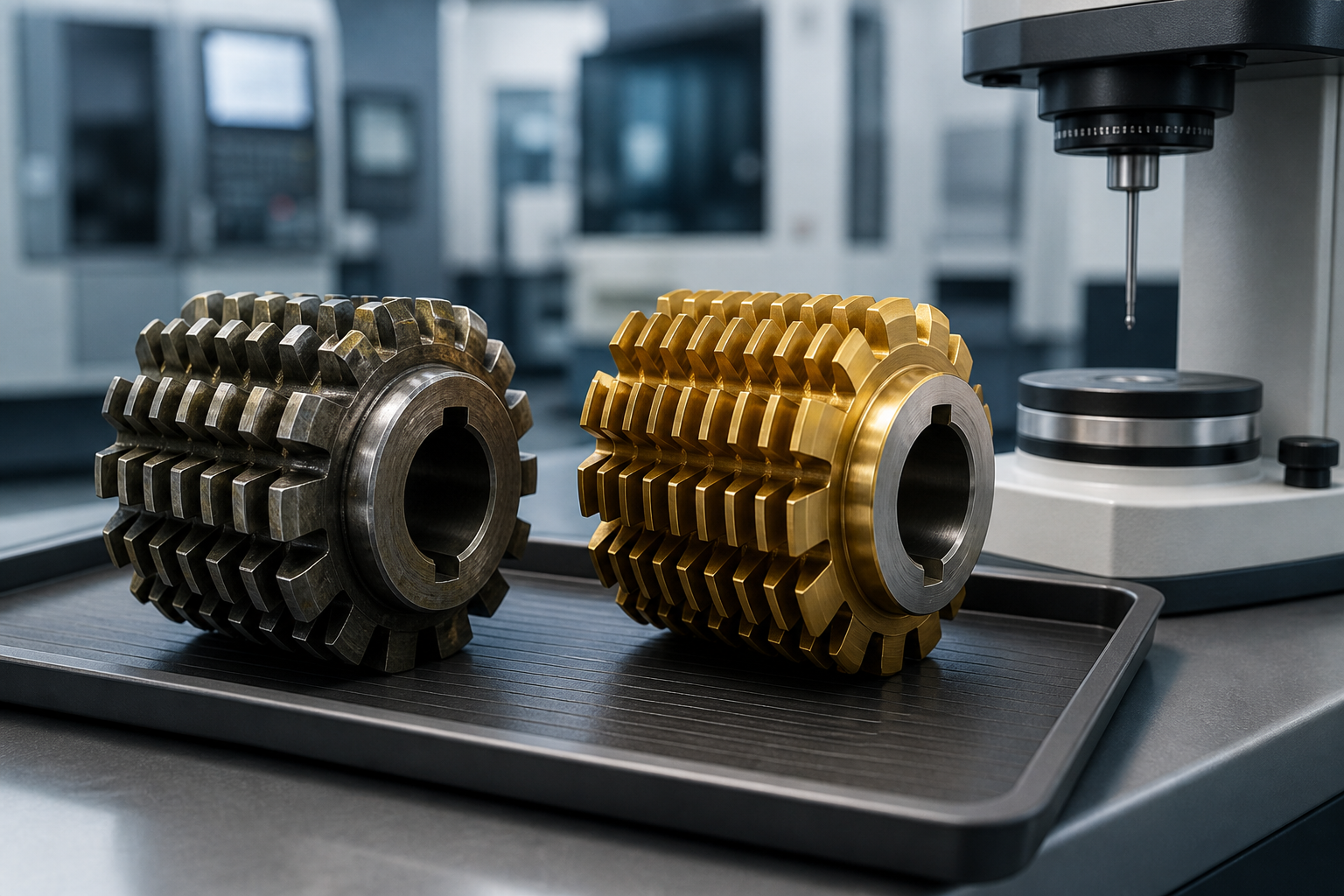
Gear Hob Regrinding Process: What Happens During Re-Coating Service
When a gear hob is removed from production, the practical next question is not simply whether it can be used again. It is what the service process will examine, where regrinding and re-coating sit in that process, and which information should accompany the tool.
Nobeve documents a complete regrinding and re-coating service sequence for gear hobs. The sequence begins with receiving, cleaning, checking and registration, then moves through wear evaluation, coating removal, regrinding, precision detection, re-coating, coating inspection, packaging and delivery. The actual suitability of a particular hob remains subject to service review; this documented sequence is not a promise that every returned tool can be reground, recoated or restored to a particular result.
The documented gear hob regrinding process
The catalogue presents the following stages in order:
- Receiving — the hob enters the service process.
- Cleaning — the tool is cleaned before subsequent review and processing.
- Checking and registration — the received tool is checked and registered.
- Wear evaluation — wear is evaluated before regrinding work proceeds.
- Coating removal — the existing coating is removed as the documented next stage.
- Regrinding — the hob is reground.
- Precision detection — precision is checked after regrinding.
- Re-coating — a coating is applied after the precision-detection stage.
- Coating inspection — the coating is inspected.
- Packaging — the serviced hob is packaged.
- Delivery — the packaged tool is delivered.
This order is useful for planning a service request because it separates the evaluation stage from the regrinding stage, and the precision-detection stage from coating inspection. It should not be used to infer a service lead time, a regrind allowance, a number of possible service cycles or an expected tool-life outcome; those points are not stated in the catalogue’s service flow.
Why re-coating is part of the service route
In the documented sequence, coating removal comes before regrinding, while re-coating and coating inspection come after precision detection. The catalogue identifies Oerlikon Balzers BALINIT® ALCRONA PRO and BALINIT® ALTENSA as coatings used in the service description, but it does not provide a rule that selects either coating for a particular returned hob or cutting application.
For a broader, older discussion of the recoat/regrind cycle, see When to Recoat Your Gear Hob. Any coating choice, geometry decision or expected result should be confirmed against the returned tool and its application rather than inferred from that general topic.
Prepare the service review with the right context
The published flow names the process stages but does not define a mandatory customer intake form. To make the review easier, identify the hob and provide the information your team has about its last application:
- The tool identification, drawing or purchase reference available to you.
- The gear operation and workpiece condition when the hob was last used.
- The machine, mounting or arbor condition and the cooling arrangement.
- What was observed before removal, such as wear, damage, an inspection concern or a process change.
- The actual bottleneck: for example, whether the priority is assessment, service feasibility, return-to-production planning or clarification of a drawing.
Describe observations rather than assigning a root cause in advance. The service review can then distinguish confirmed information from points that still need checking.
Keep sourcing and service requests separate
Regrinding and re-coating concern a returned gear hob. They should not be combined with a different tool request without defining the scope:
- For HSS hob sourcing, identify it as an HSS sourcing request and provide its own tool specification and purchasing requirements.
- For a carbide hob inquiry, provide the hobbing machine, application and component details for that new-tool request.
- For a carbide power-skiving tool, prepare a separate cutter-and-process package inquiry, including its own machine, cooling and geometry context.
This separation helps keep the returned-tool service review tied to the actual hob, while a new-tool inquiry can be assessed on its own application data.
Next step: request a gear hob service review
Send the available tool identification, process context, machine condition and observed issue through the Nobeve contact page. Ask for confirmation of the appropriate review scope before assuming that regrinding, re-coating, a coating type, delivery timing or a particular outcome applies to the returned hob.