
Introduction: Why Your Gear Tool Choice Can Make or Break an Automotive Transmission Line
Picture this: your production line is humming along, cutting transmission gears for a top-tier OEM, when suddenly tool life drops by 40% and scrap rates spike. The culprit? The wrong gear tool for the job. In the high-stakes world of automotive transmission manufacturing, this is not a hypothetical — it happens every week in plants that haven’t matched their cutting tools to their specific process conditions.
Automotive transmissions demand a level of gear accuracy that borders on obsessive. A helical gear tooth that is off by a few microns can generate noise, vibration, and harshness (NVH) that engineers will flag immediately. Yet achieving that precision at production volumes of tens of thousands of parts per month requires not just any gear tool, but the right gear tool — one selected around your material, machine, and quality target.
In this guide, you’ll find a thorough breakdown of how each class of gear cutting tool performs in automotive transmission applications, how to match tool series to production scenarios, and what cutting parameters actually look like on the shop floor. Whether you’re running a modern CNC hobbing center at 300 m/min or an older machine limited to 80 m/min, there’s a strategy here for you.
For real-world automotive case studies, visit the Nobeve Automotive Transmission Solutions page — it documents how leading transmission manufacturers are cutting cycle times and improving DIN accuracy grades with purpose-built gear tools.
What Makes Automotive Transmission Gears So Demanding
Before selecting a gear tool in automotive transmission production, you need to understand what makes these parts different from general industrial gears.
Tight Tolerance Windows
Automotive transmission gears typically require DIN Class AA or better (equivalent to AGMA Class 13–14). This means profile error, pitch deviation, and lead error must all stay within a few micrometers. A gear hob that drifts even slightly outside its re-grind tolerance will push finished parts out of spec.
High-Volume, High-Repeatability Production
Unlike job-shop environments cutting one-offs, an automotive transmission line may run 50,000+ identical gears per month on the same hobber. Tool consistency across re-grinds — not just new tool performance — is what defines true production efficiency. This favors solid carbide and PM-HSS substrates over conventional HSS, because they hold geometry tighter across multiple resharpening cycles.
Mixed Material Grades
A single transmission family might include soft-state pre-hobbing blanks (≤HRC30), carburized and case-hardened ring gears (HRC55–62), and nitrided shaft gears. No single gear tool covers all three scenarios — this is why automotive suppliers typically run multiple tool series across their product range.
Dry Cutting Pressure
Environmental regulations and coolant disposal costs are pushing many Tier-1 suppliers toward dry or near-dry machining. This is only viable with solid carbide gear hobs carrying advanced PVD coatings — not with HSS, which requires oil cooling to survive.
A Technical Overview of Gear Cutting Tool Types
Understanding the substrate and coating of a gear tool is the foundation of correct selection. Here is an accessible overview for engineers new to the topic — and a useful refresher for veterans.
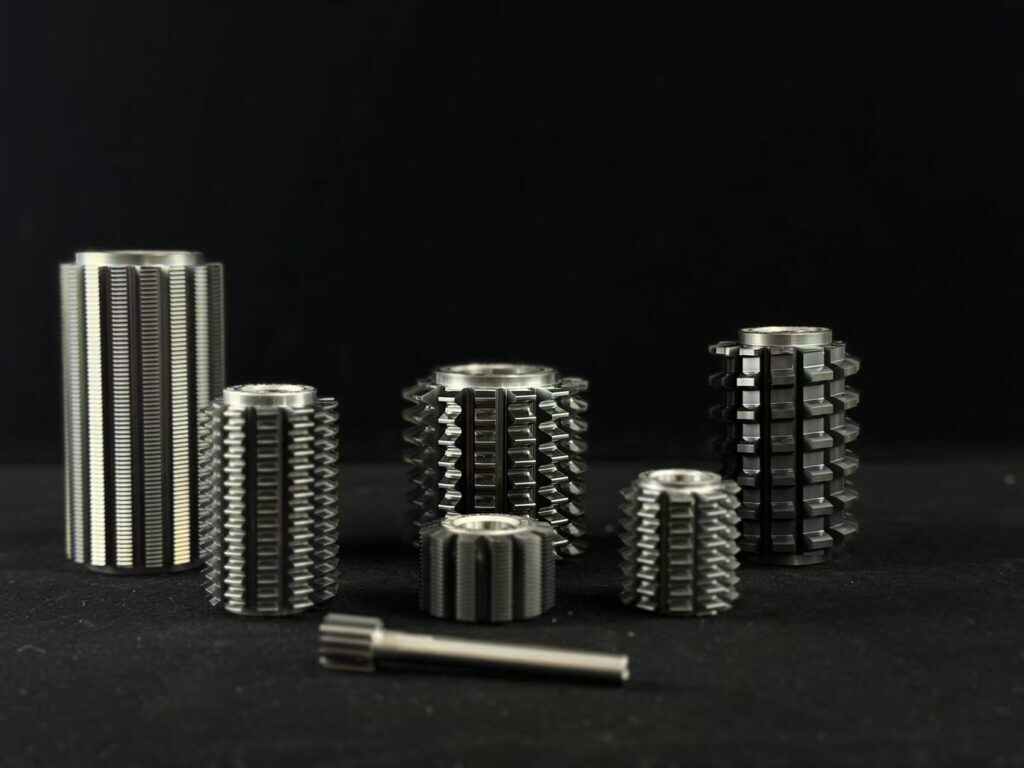
Substrate: Cemented Carbide vs. PM-HSS
The substrate determines the performance ceiling of your gear tool. According to gear cutting research published on ScienceDirect, cemented carbide (WC+Co) delivers hardness in the range of 1600–1800 HV and can sustain cutting temperatures up to 1000 °C without losing edge integrity — roughly twice the temperature ceiling of HSS. This is why carbide dominates modern automotive hobbing lines.
Powder metallurgy high-speed steel (PM-HSS), as used in Nobeve’s P-Series power skiving tools, occupies a performance band between standard HSS and carbide. Its fine, uniform grain structure — achieved by atomizing the alloy into powder before sintering — delivers superior toughness compared to cast carbide, making it the preferred substrate for power skiving soft or high-toughness materials where chip load is unpredictable.
Coating: Why PVD Matters as Much as the Substrate
Even the best substrate is limited without the right Physical Vapor Deposition (PVD) coating. Nobeve exclusively uses Oerlikon Balzers BALINIT® coatings, which have become the automotive industry benchmark for gear tools:
- ALCRONA PRO (AlCrN): Outstanding oxidation resistance up to 1100 °C, low friction coefficient, ideal for K-Series and N-Series hobbing in steel and cast iron.
- ALTENSA (AlCrVN): Specifically engineered for hard-material cutting and power skiving; the vanadium content provides self-lubricating properties that reduce built-up edge during interrupted cuts — critical for automotive gear tooth profiles.
The combination of carbide substrate + ALTENSA coating is what enables G-Series and W-Series tools to achieve dry-capable cutting performance at HRC45–62 — a specification that defines the hard-finish hobbing market in automotive transmission production.
Table 1 — Gear Tool Substrate & Performance Comparison (Nobeve Series)
| Property | Solid Carbide (K/N) | HSS | Carbide (G/W) | PM-HSS (P) |
| Cutting Speed (Vc) | 150–300 m/min | 30–60 m/min | 60–150 m/min | 60–150 m/min |
| Red Hardness | Up to 1000 °C | ~600 °C | ~600 °C | ~600 °C |
| Toughness | Moderate | Excellent | Excellent | Excellent |
| Dry Cutting | ✔ Yes | ✘ No | ✘ No | ✘ No |
| Best For | Hard steels, mass prod. | Soft steels, old machines | Hard gears, HRC55+ | Soft / tough materials |
| Nobeve Series | K-Series / N-Series | N-Series | G-Series / W-Series | P-Series |
Table 1: Key performance parameters by gear tool series. All data based on Nobeve field-tested specifications.
Matching the Right Gear Tool to Your Automotive Transmission Scenario
Here is where theory becomes practice. The following scenarios map common automotive transmission production setups to specific gear tool series recommendations.
Scenario A: High-Volume Pre-Hobbing on Modern CNC Hobbers (Soft State, ≤HRC30)
This is the bread-and-butter of automotive gear production — cutting soft blanks before heat treatment at maximum throughput.
- Recommended tool: K-Series High-Speed Dry Cutting Hobs
- Substrate: Solid carbide (Konrad Friedrichs German import rod stock, OD ≤ φ40)
- Coating: BALINIT® ALCRONA PRO or ALTENSA
- Cutting speed: 150–300 m/min, feed 0.5–0.8 mm/r
- Cooling: Dry air or oil — both supported
- Accuracy: DIN AA / DIN AAA
At 300 m/min, the K-Series cuts a typical M3 automotive pinion 3–5× faster than an HSS hob. For a line running 50,000 gears per month, that translates to substantial energy savings and freed machine capacity. The dry-cutting capability eliminates coolant costs and simplifies chip management — a real operational win for modern ISO 14001-certified plants.
Scenario B: Hard Hobbing After Heat Treatment (HRC45–62)
Many transmission designs are now hobbed after carburizing and quenching — a technique called hard hobbing that eliminates a separate grinding step. This demands the hardest, most wear-resistant gear tool available.
- Recommended tool: G-Series High-Speed Hard Cutting Hobs
- Substrate: Solid carbide (Konrad Friedrichs import), ALTENSA coating
- Cutting speed: 120–220 m/min, feed 0.15–0.35 mm/r (fine feed for DIN AA finish)
- Workpiece hardness: HRC45–62; for HRC56–62, Nobeve recommends two-pass finish hobbing
- Cooling: Oil coolant required
The ALTENSA coating’s vanadium chemistry is the key enabler here: it maintains edge sharpness at cutting temperatures that would blunt a standard AlTiN coating within a few passes. Automotive plants running the G-Series have reported tool life improvements of 30–50% versus previous carbide hobs — a significant cost reduction at OEM production volumes.
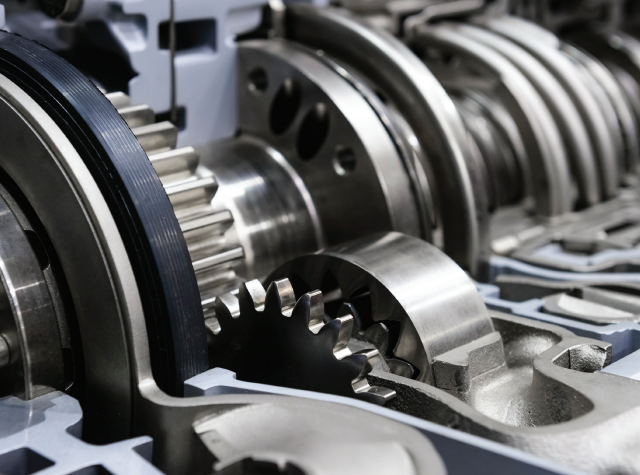
Scenario C: Legacy Machines or Job-Shop Mixed Production (≤HRC30)
Not every plant has invested in high-speed CNC hobbers. Plenty of Tier-2 and Tier-3 automotive suppliers still run older gear hobbers with spindle speeds topping out at 800–1000 RPM. For these environments, forcing a high-speed carbide tool is counterproductive — you never reach the optimal cutting speed and you pay for capabilities you can’t use.
- Recommended tool: N-Series Low-Speed Wet Cutting Hobs
- Substrate: Sintered tungsten carbide (toughness-balanced grade), ALCRONA PRO coating
- Cutting speed: 60–150 m/min, feed 0.3–0.8 mm/r
- Compatibility: Both legacy manual machines and entry-level CNCs
- Accuracy: DIN A / DIN AA
The N-Series is specifically designed to be vibration-tolerant — its impact-tough carbide grade absorbs the small oscillations common in older spindles that would chip the edges of a high-performance K or G-Series tool. Think of it as the most reliable workhorse in a mixed-equipment shop.
Scenario D: Power Skiving for Internal Gears and Clutch Drums
Automotive transmissions are increasingly incorporating internal ring gears and clutch drums that can only be efficiently produced by power skiving — a process that combines hobbing and turning kinematics to cut internal gear teeth at high speeds. This process places unique demands on the cutting tool: very high contact frequency, interrupted cuts, and demanding chip geometries.
Nobeve offers two power skiving series tailored to the automotive segment:
- W-Series Solid Carbide Power Skiving Tools (view series): Cutting speed 120–300 m/min, for materials up to HRC50. Conical and cylindrical geometries available. Requires high spindle rigidity — the carbide is hard but brittle under vibration.
- P-Series PM-HSS Power Skiving Tools (view series): Cutting speed 60–150 m/min, conical design, for soft and high-toughness materials (≤HRC30). Made from Austrian BÖHLER PM-HSS rod. The superior toughness virtually eliminates tooth edge chipping during interrupted cuts in clutch drum profiles.
The choice between W and P series for power skiving is essentially the same as the carbide-vs-PM-HSS decision in hobbing: hard and fast or tough and forgiving. For most automotive internal gear applications, the P-Series is the safer starting point unless the machine is a purpose-built power skiving center with rigid spindle confirmed.
Gear Tool Performance in Numbers: What the Data Says
Marketing claims are everywhere in the cutting tool industry. Here is what the actual numbers look like for automotive transmission gear production using Nobeve tool series, based on documented shop-floor data:
| Metric | K-Series | G-Series | N-Series | W / P-Series |
| Max Cutting Speed | 300 m/min | 220 m/min | 150 m/min | 300 / 150 m/min |
| Max Workpiece Hardness | HRC 45 / 55* | HRC 62 | HRC 30 | HRC 50 / HRC 30 |
| Dry Cutting Capable | Yes | No (oil) | No (oil) | No (oil) |
| Accuracy Grade | DIN AAA | DIN AAA | DIN AA | DIN AA |
| Typical Gear Module | M1–M8 | M1–M6 | M1–M10 | M1–M6 |
| Re-grind Cycles | High (carbide) | High (carbide) | Medium | Medium–High |
Table 2: Nobeve gear tool series performance overview for automotive transmission applications. *EVO coating ≤HRC45; AT coating up to HRC55.
Common Gear Tool Mistakes in Automotive Transmission Production — And How to Fix Them
After working with dozens of automotive Tier-1 and Tier-2 suppliers, the Nobeve engineering team has identified five recurring mistakes that consistently erode tool life and gear quality. Here they are — with fixes.
Mistake #1: Running a Soft-Material Hob on a Hard-Tooth Application
A K-Series hob rated for ≤HRC45 (with ALCRONA PRO) will experience accelerated flank wear if used on a carburized gear at HRC55. The solution is simple: upgrade to G-Series with ALTENSA coating, which is rated to HRC62 specifically for hard hobbing.
Mistake #2: Ignoring Machine Spindle Rigidity for Power Skiving
Selecting a W-Series carbide skiving tool on a machine with measurable spindle runout (>5 μm) will almost always lead to premature chipping of the carbide teeth — carbide is hard but sensitive to vibration. If the machine cannot guarantee rigidity, switch to the P-Series PM-HSS, which absorbs vibration without chipping.
Mistake #3: Skipping Re-grind Quality Checks
Carbide gear hobs can be re-ground multiple times, but each re-grind must maintain the original rake and relief angles within tight tolerances. A poorly re-ground hob operating at 300 m/min will generate heat asymmetrically and fail early. Nobeve recommends in-house re-grind verification on a gear tool measuring machine after every cycle.
Mistake #4: Using One Feed Rate Across All Materials
Feed rate profoundly affects both gear tooth surface finish and tool life. For the G-Series on hard materials (HRC55+), Nobeve specifies 0.15–0.35 mm/r — tighter than the 0.5–0.8 mm/r used on K-Series soft cutting. Running a hard-cutting hob at 0.5 mm/r will shorten edge life dramatically.
Mistake #5: Treating HSS and Carbide Hobs as Interchangeable
This is perhaps the most common misconception in plants that are transitioning from legacy to modern production. Carbide hobs require 3–5× the spindle speed to reach optimal cutting temperature for the coating to activate properly. Running carbide at HSS speeds wastes the tool’s capability and can actually cause more wear than running HSS at its correct speed.
Frequently Asked Questions (FAQ)
Q1: What is the best gear tool for automotive transmission gears made from 20CrMnTi or 20MnCr5?
Both 20CrMnTi and 20MnCr5 are standard carburizing grades used widely in Chinese and European automotive transmission production respectively. In soft state (pre-carburizing, ≤HRC30), the K-Series is ideal for high-speed dry or wet hobbing. After carburizing and hardening to HRC58–62, you need the G-Series for hard hobbing — and for HRC60+, Nobeve recommends a two-pass strategy (roughing pass at higher feed, finish pass at lower feed) to protect the tool edge.
Q2: Can I use a gear hob for both module 2 and module 4 gears on the same machine?
Not with the same hob. Gear hobs are module-specific — the tooth profile geometry is directly tied to the module. However, within a single module, you can run different pressure angles on some multi-start designs. Consult Nobeve’s engineering team via the contact page for application-specific hob recommendations.
Q3: How does dry cutting compare to wet cutting for automotive gear production?
Dry cutting with a K-Series carbide hob at 200–300 m/min generates heat that is mostly carried away in the chip — the PVD coating acts as a thermal barrier. Wet cutting adds coolant mainly for chip flushing and dimensional stability of the workpiece. For modern CNC hobbers with good chip evacuation, dry cutting is often preferred because it eliminates coolant disposal cost and HSE risk. For hard hobbing (G-Series), oil coolant remains necessary to manage the higher cutting forces at lower feed rates.
Q4: What accuracy grade can I expect from Nobeve gear hobs in automotive production?
K-Series and G-Series tools are certified to DIN AAA — the highest accuracy grade for gear hobs, equivalent to AGMA Class C. N and P series achieve DIN AA. In practice, the finished gear accuracy will be influenced by machine condition, workpiece fixture, and re-grind quality in addition to the hob specification.
Q5: Where can I see automotive customer case studies for Nobeve tools?
Nobeve publishes documented case studies on the Automotive Transmission Solutions page, including specific production data from Tier-1 suppliers. This page also includes a downloadable technical questionnaire so Nobeve engineers can provide a tailored tool recommendation for your specific part and machine combination.
Q6: Is PM-HSS really better than standard HSS for power skiving?
Yes — by a significant margin. Conventional cast HSS has a coarser carbide grain structure that limits both toughness and re-grind consistency. PM-HSS (like the Austrian BÖHLER grade used in Nobeve P-Series) is atomized into powder before sintering, producing a uniform nano-grain microstructure that delivers 20–30% higher toughness and dramatically better dimensional stability across re-grinds. For power skiving in automotive clutch drums, that toughness advantage directly translates to lower edge chipping rates and longer production campaigns.
About Nobeve Precision Gear Tools
Nobeve is a specialist gear cutting tool manufacturer with a product line built from the ground up for the demands of the automotive, aerospace, and industrial gear sectors. Every tool in the Nobeve range uses:
- German and Austrian import rod stock (Konrad Friedrichs carbide, BÖHLER PM-HSS) — never generic domestic material
- Oerlikon Balzers BALINIT® coatings (ALCRONA PRO, ALTENSA) — the automotive PVD benchmark
- In-house precision grinding verified to DIN AA / DIN AAA specifications
Explore the full Nobeve gear tool range on the Nobeve official website, including the K-Series, G-Series, N-Series, W-Series, and P-Series.
Learn more about Nobeve’s manufacturing philosophy and quality certifications on the About Us page.
Conclusion: The Right Gear Tool Is a Production Decision, Not Just a Purchase
Choosing a gear tool for automotive transmission production comes down to a three-factor triangle: workpiece hardness, machine capability, and volume target. Get all three right and you’ll see DIN AAA gears coming off the line at maximum throughput with minimal tool changes. Get one wrong and you’re fighting scrap, chipping, and unplanned downtime.
The framework is clear:
- Soft material + modern high-speed machine = K-Series (dry if possible, maximum throughput)
- Hard material post-heat treatment = G-Series (ALTENSA coating, oil coolant, fine feed)
- Legacy machine or job-shop = N-Series (vibration-tolerant, proven ROI at any volume)
- Power skiving internal gears: W-Series (rigid machine) or P-Series (soft/tough materials, chipping prevention)
| Ready to optimize your automotive gear production? Get a free gear tool recommendation from Nobeve engineers — based on your specific partand machine. Contact Nobeve Engineering Team | View Automotive Case Studies |

