

Why Gear Tools Determine Whether a Surgical Robot Succeeds or Fails
You're a procurement or process engineer at a medical device manufacturer. Your surgical robot's elbow joint has just failed calibration — and the root cause is a gear profile deviation of 4 microns. Four microns. That's roughly 1/20th the width of a human hair, yet it's enough to compromise a life-saving procedure.
Precision gear transmission sits at the heart of modern medical technology: surgical robots, orthopedic implants, diagnostic imaging drives, powered prosthetics, and infusion pumps all rely on gears that must perform flawlessly under sterile, load-varying, and often miniaturized conditions.
Yet many manufacturers still treat the gear tool as a commodity purchase — comparing only price, ignoring substrate, coating, cutting speed, and rigidity compatibility. The result is either scrapped parts or field failures that carry serious regulatory consequences.
In this guide, you will learn exactly which gear cutting tool to specify for each medical device application, why substrate and coating matter as much as geometry, and how Nobeve Precision Tools — a specialist manufacturer with dedicated medical device case studies — addresses these challenges with purpose-engineered hob and power skiving solutions.
What Makes Gear Tool Selection Uniquely Demanding in Medical Applications
Material Complexity: Titanium, CoCr, and Stainless
Medical gears are rarely made of mild steel. Surgeons and regulators demand biocompatible alloys:
- Ti-6Al-4V (Grade 23) — Used in orthopedic and spinal implant drives. High strength-to-weight ratio, but notoriously abrasive to cutting tools.
- Cobalt-Chrome (CoCr) — Common in knee and hip replacement actuators. Hardness can reach HRC 40–50 after heat treatment.
- 316L Stainless Steel — Standard for instrument drives; work-hardens rapidly during cutting.
- PEEK composites — Emerging in minimally invasive tools; requires specific geometry and low-heat cutting.
Each alloy demands a different gear tool substrate, coating, and cutting parameter. Using a standard hob designed for automotive gears on Ti-6Al-4V is a guaranteed path to premature tool failure and out-of-tolerance parts.
Tolerance Bands That Leave No Room for Error
AGMA Quality 14 and DIN Class AA are now table stakes for medical transmission gears. Profile deviation tolerances frequently fall below ±3 µm, and lead tolerances below ±2 µm. Achieving this consistently requires:
- Tool runout < 3 µm (verified per DIN 8187)
- Substrate hardness and thermal stability to maintain edge integrity over the full cut
- Coatings that reduce built-up edge (BUE) formation on sticky alloys like 316L
The gear tool itself must be manufactured to DIN AA or AGMA Class A — the standard applied across Nobeve's K, G, W, and P series lines.
Regulatory and Cleanroom Constraints
FDA 21 CFR Part 820 and ISO 13485 require full traceability and process validation. This means:
- Coolant selection can affect biocompatibility validation — dry cutting (enabled by Nobeve's K-Series) simplifies this
- Tool change intervals must be documented and repeatable — inconsistent tool life destroys validation data
- Surface finish (Ra) must be proven per batch — only tools with stable wear profiles can achieve this
Choosing the Right Gear Tool for Your Medical Device Application
Not all gear tools are equal — and in medical manufacturing, the wrong choice isn't just costly, it's a compliance risk. Here's how to map your application to the right Nobeve series.
High-Speed Carbide Hobs for Orthopedic and Robotic Joint Drives
For high-volume, high-hardness workpieces (CoCr, hardened stainless, or carburized alloy steel up to HRC 55), the Nobeve K-Series High-Speed Dry Cutting Hob is the benchmark choice.
- Substrate: Konrad Friedrichs (Germany) solid carbide rod — WC+Co grade, imported and verified per batch
- Coating: BALINIT® ALCRONA PRO or ALTENSA — AlCrN-based, biocompatible, thermally stable to 1,100 °C
- Cutting speed: 150–300 m/min, enabling dry cutting in cleanroom-adjacent environments
- Workpiece hardness: ≤ HRC 45 (EVO coating) or HRC 35–55 (AT coating)
- Precision grade: DIN AA / AGMA A — meeting medical transmission requirements
The K-Series eliminates cutting oil from the process, which directly simplifies ISO 13485 process validation and reduces coolant-related contamination risk — a significant advantage for Class II and Class III device manufacturers.
Hard Gear Finishing for Implant-Grade Gears
When gears are carburized and quenched to HRC 58–62 before the final gear-cutting pass, the Nobeve G-Series Hard Cutting Hob handles the finishing role that grinding would otherwise occupy.
- Recommended speed: 120–220 m/min with oil cooling
- Feed: 0.15–0.35 mm/r — controlled for surface finish integrity
- Hardness range: HRC 45–62 (HRC 56–62 via secondary finish-hobbing pass)
This makes the G-Series the preferred gear tool for orthopedic knee and hip drive actuators where post-grind gear quality must be maintained without distortion.
Power Skiving for Internal Gears and Ring Gears in Surgical Robots
Many surgical robot joint architectures use internal ring gears — components impossible to hob conventionally. Power skiving has emerged as the production method of choice, and two Nobeve series address different requirements:
W-Series — Solid Carbide Power Skiving Tool (view specs)
- Ideal for hardened materials and cylindrical designs with low skiving angles
- Cutting speed: 120–300 m/min — maximizes throughput on CNC turn-mill centers
- Requires high-rigidity machine spindles — essential to prevent chipping on carbide edges
- Workpiece hardness: ≤ HRC 50
P-Series — PM-HSS Power Skiving Tool (view specs)
- Austrian BÖHLER PM-HSS substrate — toughness between conventional HSS and carbide
- Conical design absorbs vibration — critical when machining thin-walled ring gear blanks
- Cutting speed: 60–150 m/min with oil cooling
- Workpiece hardness: ≤ HRC 30 — optimized for soft titanium and 316L stainless in initial passes
See Nobeve's dedicated medical device application page for documented case studies on surgical robot ring gear production using W-Series and P-Series tools.
Legacy Machine Work: N-Series for Job Shop and Mixed Environments
Not every medical device supplier runs the latest CNC gear centers. For job shops operating legacy hobbers or mixed environments, the Nobeve N-Series Low-Speed Hob delivers DIN A / AA precision with inherent vibration tolerance.
- Sintered WC-Co grade balanced for toughness — resists chipping on less-rigid setups
- Speed: 60–150 m/min with oil cooling
- Workpiece: ≤ HRC 30 — gear blanks in soft stainless or annealed Ti alloys
The N-Series is the intelligent cost-efficiency choice for low-to-medium volume medical gear production where machine vintage limits cutting speed but DIN AA accuracy remains non-negotiable.
Gear Tool Comparison: Nobeve Series Mapped to Medical Applications
The table below maps each Nobeve gear tool series to its optimal medical device application, key parameters, and clinical relevance:
| Parameter | Carbide (K/G/W Series) | PM-HSS (P Series) | Medical Relevance |
| Cutting Speed (Vc) | 150–300 m/min | 60–150 m/min | Carbide cuts faster — vital for high-volume implant runs |
| Workpiece Hardness | Up to HRC 62 | ≤ HRC 30 | Carbide handles hardened Ti/CrCo alloys |
| Toughness / Vibration | Lower (needs rigid spindle) | Excellent (absorbs shock) | PM-HSS for older machines or complex profiles |
| Dry / Wet Cutting | Dry or oil-cooled (K-Series) | Oil-cooled only | Dry cutting avoids coolant contamination in cleanrooms |
| Coating | BALINIT® ALTENSA / ALCRONA PRO | BALINIT® ALTENSA | Both provide biocompatible, low-friction surface |
| Typical Medical App. | Orthopedic implants, robotic joints | Soft-alloy gears, legacy machine work | Match tool to material and machine |
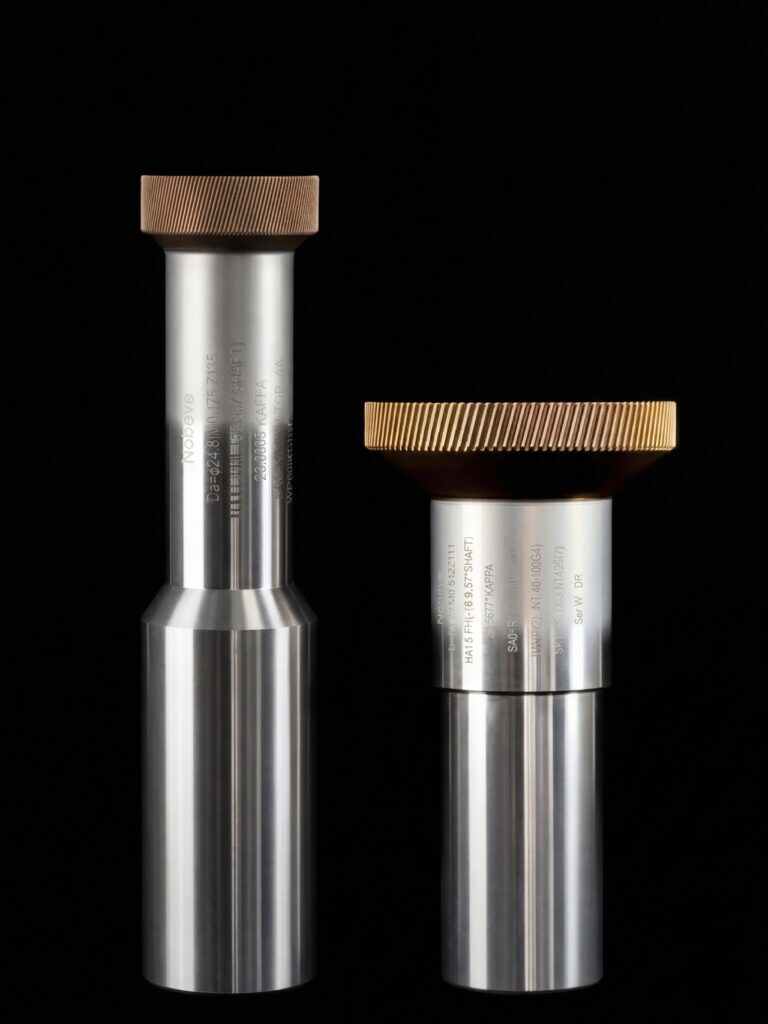
Why Coating Is the Hidden Variable in Medical Gear Tool Performance
A common industry misconception: "If the substrate is right, the coating is just a bonus." In medical manufacturing, this thinking leads to disaster.
Nobeve applies Oerlikon Balzers BALINIT® coatings — either ALCRONA PRO (AlCrN) or ALTENSA — across all series, even the PM-HSS P-Series and the lower-cost N-Series. Here's why this matters for medical applications:
- Biocompatibility: BALINIT® coatings are inert and do not transfer harmful elements to the workpiece surface — critical for implant-grade components
- Thermal barrier: ALTENSA maintains hardness above 1,100 °C, preventing edge softening during dry cutting (K-Series) on titanium
- Built-up edge (BUE) prevention: The low friction coefficient of AlCrN-based coatings prevents 316L stainless from welding to the cutting edge — a leading cause of surface finish degradation
- Extended tool life: Consistent wear curve enables predictable tool change intervals, which is a mandatory element of ISO 13485 process validation
Oerlikon Balzers, the coating supplier, is an industry authority in PVD coatings for precision tooling, and their technology is documented in peer-reviewed machining literature. Nobeve's decision to specify these coatings across all product lines — not just the premium K-Series — reflects a commitment to traceable, validated performance.
The Medical Device Gear Tool Selection Framework
Use this step-by-step decision framework to specify the correct gear tool in medical device applications:
Step 1 — Identify workpiece material and hardness:
- Titanium alloy / 316L ≤ HRC 30 → P-Series (skiving) or N-Series (hobbing)
- CoCr / carburized stainless HRC 45–55 → K-Series (hobbing) or W-Series (skiving)
- Hardened gear finishing HRC 55–62 → G-Series (finish hobbing)
Step 2 — Identify gear geometry:
- External spur / helical → K, G, or N Series hobs
- Internal ring gear → W-Series (carbide, rigid machine) or P-Series (PM-HSS, flexible machine)
Step 3 — Assess machine capability:
- High-speed CNC gear center (>2,000 rpm spindle) → K or W Series
- Legacy gear hobber or mixed CNC → N or P Series
Step 4 — Consider regulatory environment:
- ISO 13485 cleanroom process validation requiring no coolant → K-Series dry cutting
- Standard machining environment → any series with oil cooling
| Nobeve Engineering SupportIf your application doesn't map cleanly to a single series, Nobeve's engineering team provides free application consultation. Visit https://nobeve-tool.com/contact-us/ to submit your workpiece details and receive a written tool recommendation. |
Frequently Asked Questions
Q: Can a standard automotive gear hob be used for medical device gears?
A: Technically yes, but practically no. Medical gear tolerances (DIN AA / AGMA 14) and workpiece materials (titanium, CoCr) demand tools manufactured and validated to those specific grades. Standard automotive hobs typically target DIN A precision and are optimized for medium-carbon steel — using them on biocompatible alloys results in rapid wear and out-of-tolerance profiles that fail ISO 13485 process validation.
Q: Why does Nobeve use BÖHLER PM-HSS in the P-Series instead of conventional HSS?
A: Powder metallurgy high-speed steel (PM-HSS) has a more uniform carbide distribution than conventionally melted HSS, resulting in higher toughness, better grindability, and more consistent performance. For medical applications where tool life repeatability is a validated process parameter, this consistency is not optional — it's a compliance requirement. BÖHLER is the same Austrian PM-HSS supplier used by top European precision toolmakers.
Q: Is dry cutting (K-Series) suitable for titanium alloys?
A: Yes, with caveats. The K-Series with BALINIT® AT coating is designed for cutting speeds up to 300 m/min in dry or air-cooled conditions and handles workpiece hardness up to HRC 55. Ti-6Al-4V falls within this range when properly annealed. However, for work-hardening variants or thin-walled blanks, a reduced-speed oil-cooled approach with the N or P Series may produce better surface finish outcomes.
Q: How does Nobeve support ISO 13485 documentation requirements?
A: Nobeve provides batch-level material certificates for all substrates (Konrad Friedrichs carbide, BÖHLER PM-HSS), coating run reports from Oerlikon Balzers, and dimensional inspection reports per DIN 8187 for every hob or skiving tool. This documentation package directly supports the tooling control section of a medical device manufacturer's quality management system.
Q: What are typical tool life expectations for Nobeve gear tools on CoCr alloys?
A: Tool life varies significantly by cutting parameters, but in validated production environments, Nobeve G-Series hobs on CoCr (HRC 45–55) achieve 800–1,200 gear cycles before regrind, and W-Series carbide skiving tools on similar materials achieve 600–900 cycles. Regrind capability extends tool life up to 6–8 cycles before replacement, depending on substrate condition.
Q: Where can I see real medical device applications of Nobeve tools?
A: Nobeve maintains a dedicated medical device application library at https://nobeve-tool.com/medical-device/ — including documented case studies on surgical robot ring gear production and orthopedic implant drive components.
Technical References and Further Reading
The following authoritative sources informed the technical specifications and application guidance in this article:
- American Gear Manufacturers Association (AGMA) — AGMA 2000-A88 and 2015 gear quality standards referenced for tolerance classification
- ISO 13485:2016 — Medical Devices Quality Management Systems — Framework for process validation requirements governing cutting tool documentation
- Oerlikon Balzers BALINIT® Coating Technology — Technical data for ALCRONA PRO and ALTENSA PVD coatings
Conclusion: Precision Gear Tools Are Non-Negotiable in Medical Manufacturing
In medical device manufacturing, the gear tool is not a background consumable — it is a critical process input that directly determines whether your product meets its tolerance, surface finish, and biocompatibility requirements. The wrong substrate, incorrect coating, or mismatched cutting speed doesn't just waste tool budget: it invalidates process qualification and, ultimately, delays market authorization.
Nobeve's medical-specific lineup — K, G, N, W, and P Series — provides a mapped solution for every combination of workpiece material, machine capability, and gear geometry encountered in modern medical device manufacturing. With BÖHLER PM-HSS substrates, German Konrad Friedrichs carbide, and Oerlikon Balzers BALINIT® coatings, every tool is built to the documentation standard that ISO 13485 demands.
The next step is simple: describe your application to Nobeve's engineering team and receive a written tool recommendation, including cutting parameters and expected tool life — at no cost.
| Ready to Specify the Right Gear Tool for Your Medical Device Application? Visit Nobeve's medical device application page for case studies: https://nobeve-tool.com/medical-device/ Or contact the engineering team directly: https://nobeve-tool.com/contact-us/ |