
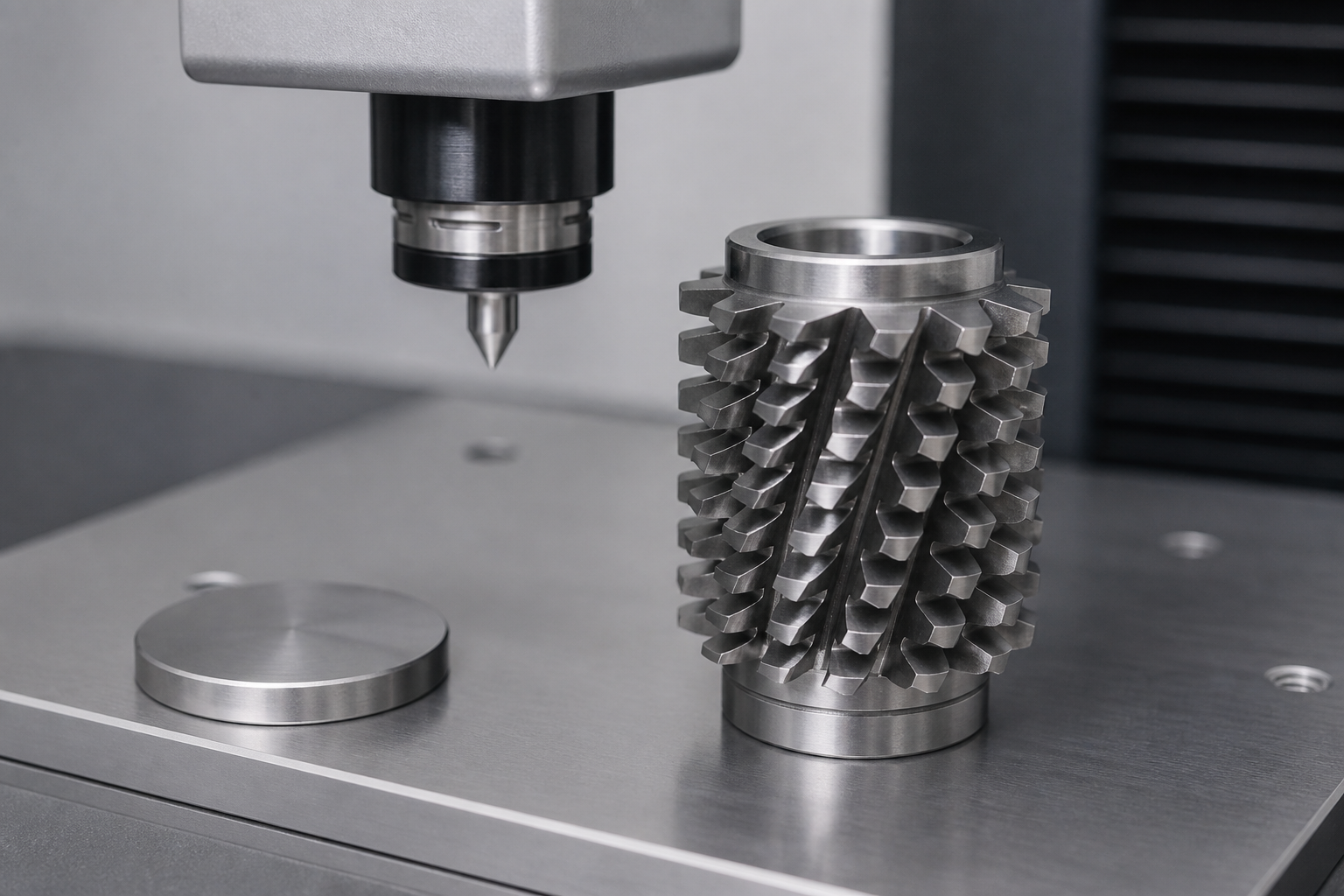
Gear Tool Hardness Selection: Questions That Lead to a Better Inquiry
When a gear-tool inquiry starts with only a material name, the selection discussion is incomplete. The workpiece hardness at the cutting stage is a key input, but it has to be read together with the process route, machine and cooling condition.
For Nobeve’s documented series, hardness can narrow the initial conversation. It does not, by itself, approve a tool, cutting speed or expected tool life. Start with the actual hardness value and test method, then give the application engineer the machining conditions needed to review the fit.
Start with the hardness at the moment of cutting
Ask for the workpiece hardness that applies before the gear teeth are cut, not only the final heat-treatment target. Record the value and unit exactly as supplied—for example, HRC—and state whether it is a drawing requirement, a material certificate value or a measured production value.
The documented Nobeve recommendations create these initial review windows:
| Process and series | Documented workpiece-hardness recommendation | Conditions that still need confirmation |
|---|---|---|
| K-Series high-speed dry-cutting hobs | Up to HRC 45 with EVO coating; HRC 35 to HRC 55 with AT coating | High-speed hobbing machine; air-cooled dry cutting or oil-cooled environment; coating selection |
| G-Series high-speed hard-gear hobs | HRC 45 to HRC 62 | High-speed hobbing machine and oil-cooled environment; at HRC 56 to HRC 62, a secondary finish-hobbing pass is recommended |
| N-Series low-speed soft-gear oil-cutting hobs | Up to HRC 30 | Oil-cooled environment and machine speed/condition |
| P-Series PM-HSS gear skiving tools | Up to HRC 30 | Oil-cooled wet cutting; compatible gear hobbing machine or turn-mill center |
| W-Series carbide gear skiving tools | Up to HRC 50 | Oil-cooled environment; compatible gear turning machine or turn-mill center; spindle rigidity |
These are series-level recommendations from the Nobeve Series Description, not a substitute for a reviewed drawing or process plan. A value that sits near an overlap or boundary should trigger a more detailed engineering discussion, rather than an assumption that two series are interchangeable.
Choose the process family before comparing tool materials
Hardness is only one part of the selection path. First identify whether the request is for hobbing or power skiving.
For a gear hob inquiry
State whether the requirement is for an HSS hob sourcing request or for a carbide hob selection. Then provide the gear drawing, workpiece hardness at cutting, cooling method, machine type and the current production bottleneck. The K-, G- and N-Series descriptions also differentiate high-speed and low-speed machine contexts as well as dry/air-cooled or oil-cooled environments.
For workpieces documented in the higher-hardness G-Series range, note whether the hardness is HRC 56 to HRC 62. The source specifically recommends a secondary finish-hobbing pass for that range; it does not state that this is required for every part or machine.
For a power skiving inquiry
Do not treat a carbide tool request as an automatic answer to a harder workpiece. The documented P-Series PM-HSS and W-Series carbide recommendations have different hardness windows, machine compatibility and operating conditions.
For a W-Series inquiry, include spindle-rigidity information and any observed vibration. The source says excessive vibration can lead to tool chipping, so this machine-condition input is material to the review. For a P-Series inquiry, include the cooling condition and whether the part and machine match the documented wet-cutting and compatible-machine context.
For an overview of the information used to begin this discussion, see our gear material and tool-selection guide. Its material-specific recommendations should be reviewed against current first-party product data before a tool is specified.
Use hardness to ask better questions—not to promise a result
Before requesting a quotation or a technical recommendation, prepare this short brief:
- What is the workpiece hardness at the cutting operation, including the unit and source of the value?
- Is the operation hobbing or power skiving, and is the request for HSS hob sourcing, carbide hob selection, or a carbide power-skiving package?
- What machine will run the tool, and what are its relevant condition details, including spindle rigidity where applicable?
- Is the process dry with air cooling or oil-cooled, and is that condition fixed or open to review?
- What is the bottleneck: chatter, edge chipping, wear, cycle-time pressure, surface quality or another observed issue?
- What drawing, gear geometry, accuracy requirement and current process information can be shared for review?
This format helps avoid treating a hardness range as a performance guarantee. It also gives an engineer enough context to check whether the documented series conditions match the actual application.
What to do when the hardness is outside—or close to—the stated range
Do not extend a series recommendation beyond its documented range in an RFQ. Instead, mark the hardness, cooling condition and machine setup for engineering confirmation. The same caution applies when a part may be cut in more than one condition, such as before and after a heat-treatment stage: identify the exact operation being quoted.
If the main problem is vibration or chipping, report it alongside hardness rather than changing the requested tool material based on hardness alone. In the W-Series description, spindle rigidity is specifically identified as a concern because excessive vibration can lead to chipping.
Bring the complete input set to the tool review
Workpiece hardness is a useful first filter for gear tool selection, but the documented Nobeve ranges operate with stated machine and cooling contexts. Send the part drawing, hardness at cutting, process type, cooling method, machine condition and production bottleneck for a review that can distinguish an HSS hob sourcing request from a carbide package inquiry.
To start that review, contact the Nobeve engineering team with the information above and identify which decision needs confirmation before tooling is specified.