
Every modern tractor, combine harvester, or sugar-cane loader depends on a precisely manufactured gear tool to shape the gears that transfer engine power to the ground. Yet the agricultural machinery sector presents a uniquely paradoxical manufacturing challenge: OEM factories must produce millions of gears at the lowest possible cycle time, while repair workshops need tools that survive aging, low-rigidity machines at minimal cost. A single solution cannot satisfy both demands. This article explores how Nobeve Tool addresses both segments with purpose-engineered hobs and power skiving cutters, drawing on real application scenarios documented on the Nobeve agricultural machinery page.
Agricultural gears operate as a sophisticated power-distribution network. Transmissions, power-take-off (PTO) systems, final-drive axles, and hydraulic pump drives all rely on helical gears, spur gears, spline shafts, and internal ring gears to convert engine torque into field work. Understanding the specific machining challenges in each of these sub-systems is the foundation for selecting the right gear tool for the job.
Understanding the Agricultural Gear Machining Environment
The "Mud & Shock" Factor
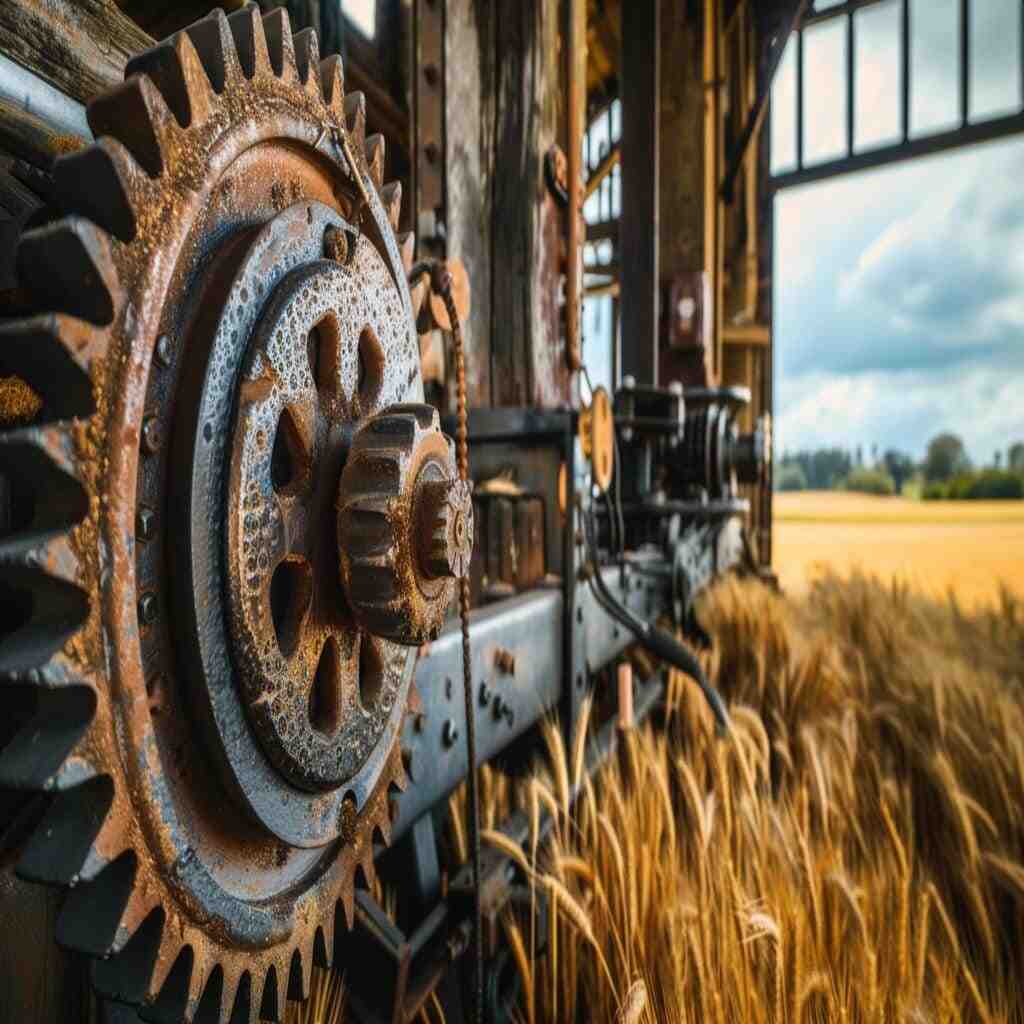
Agricultural machinery operates in some of the harshest conditions on earth: thick mud, abrasive dust, and sudden shock loads are daily realities. Gears must therefore undergo deep case-carburizing to achieve the wear resistance required for long service life. This heat-treatment step creates a specific gear tool requirement: every cutting pass during the "green" (pre-hardened) stage must leave a perfectly controlled grinding allowance so that the post-heat-treatment grinding wheel touches only the active flank, never the root fillet. Grinding burn at the root would create stress risers that lead to fatigue fracture in the field—an unacceptable outcome for a tractor in the middle of a harvest.
The Cost–Volume Paradox
OEM manufacturers face relentless production pressure. A major tractor line may require more than 100,000 helical gear sets per year, so every second of cycle time translates directly to profitability. In contrast, the aftermarket repair sector is fragmented and cost-sensitive: a workshop in Brazil or India may process only a handful of replacement spline shafts per week on a 30-year-old manual hobbing machine. The gear tool economics are completely different between these two worlds, and treating them as one market leads to either over-engineering costs or tool failures.
Key Gear Systems in Agricultural Machinery
Nobeve engineers four distinct gear systems when designing tools for the agricultural sector:
- Transmission Systems: PowerShift and CVT gearboxes use dense arrangements of helical and spur gears to regulate speed-torque balance. Critical parts include input shafts and cluster gears.
- Power Take-Off (PTO): PTO systems drive external implements such as balers via spline shafts designed to absorb immense instantaneous shock loads.
- Final Drive & Axles: Planetary gear sets with internal ring gears bear the highest drivetrain torque loads when driving large wheels.
- Hydraulic Systems: Steering and lifting depend on gear pumps where precision external gears maintain stable fluid pressure and low noise.
Application Case Study 1: OEM Transmission Production (K-Series Gear Tool)
Target Component and Challenge
In high-volume OEM factories, the primary targets are transmission helical gears and PTO shaft splines. Annual production volumes exceeding 100,000 units demand a cycle-time-optimized gear tool that can sustain consistent DIN quality class AA or AAA without frequent resharpening stoppages. At the same time, protuberance geometry must be ground into the hob to protect root fillets after carburizing.
Nobeve Solution: K-Series High-Speed Dry-Cutting Hob
The K-Series High Speed Dry Cutting Hob was engineered precisely for this environment. Key specifications:
- Substrate: German-imported Konrad Friedrichs solid carbide bar stock (WC+Co), ground to ultra-fine 0.2 µm grain for minimum micro-waviness on the tooth surface.
- Coating: Oerlikon Balzers BALINIT® ALCRONA PRO or ALTENSA — thermal stability up to 1,100 °C, directing heat into chips rather than the tool or workpiece.
- Cutting Speed: Recommended 150–300 m/min, dry or air-cooled — eliminating coolant costs entirely.
- Precision: DIN class AA and AAA, with Adjacent Pitch Error (fp) tightly controlled to reduce NVH in high-speed CVT transmissions operating above 50 km/h.
- Protuberance Design: Custom protuberance hobs pre-cut the root depth so post-hardening grinding wheels avoid the tooth root fillet, preventing stress risers and fatigue failures.
A gear process engineer documented that K-Series hobs running dry at 280 m/min consistently held DIN class 7 quality over 3,000 parts per regrind cycle on a Liebherr LC high-speed machine — a result that meaningfully reduces cost-per-part for OEMs.
Why Not HSS for OEM Transmission?
High-speed steel hobs are limited to approximately 60–150 m/min and require oil cooling, which adds fluid management costs and environmental compliance burdens. For high-volume OEM production lines with rigid, modern CNC hobbing machines (spindle > 2,000 RPM), the carbide gear tool is the only path to the throughput economics that automotive-grade agricultural OEMs demand.
Application Case Study 2: Final Drive Ring Gear Finishing (W-Series Power Skiving)
Target Component and Challenge
The final-drive planetary ring gear is one of the most demanding components in agricultural machinery. It transmits the drivetrain's highest torque loads directly to the wheels, and must therefore be carburized and hardened — typically reaching HRC 45–50. However, ring gear geometry distorts significantly after heat treatment, making gear shaping on the hardened surface impractical and gear grinding slow and expensive.
Nobeve Solution: W-Series Solid Carbide Power Skiving Cutter
The W-Series Solid Carbide Power Skiving Tool resolves this impasse through hard skiving — a continuous rotary cutting process that removes material from the hardened gear surface at high speed, actively correcting pitch and runout errors introduced by heat-treatment distortion.
- Substrate: Cold-forged sintered WC+Co alloy — high hardness specifically suited for cutting materials up to HRC 50.
- Coating: BALINIT® ALTENSA for optimal edge protection at elevated temperatures.
- Speed Range: 120–300 m/min with oil cooling.
- Geometry: Conical or cylindrical design — conical geometry offers advantages for cutting hard materials; cylindrical geometry enables small-axis-crossing-angle skiving of softer materials.
A production manager at a final-drive assembly plant reported that switching from gear grinding to W-Series hard skiving on a Gleason 600PS power skiving machine delivered a direct reduction in ring gear finishing cycle time, with impressive tool life sustained throughout production runs of hardened HRC 50 ring gears.
Why W-Series and Not P-Series for Ring Gears?
The P-Series PM-HSS Power Skiving Cutter is manufactured from Austrian-imported BÖHLER powder metallurgy high-speed steel (PM-HSS) — a premium substrate that outperforms conventional HSS in toughness. However, even PM-HSS lacks the hardness required to cut carburized steel at HRC 45–50. Sustained contact with hardened steel causes rapid softening and accelerated flank wear. For ring gear hard skiving, only the W-Series solid carbide gear tool achieves the necessary material removal rate and edge stability.
Application Case Study 3: Aftermarket Repair — Replacement Spline Shafts (N-Series Hob)
Target Component and Challenge
Agricultural machinery aftermarket repair is a global, fragmented market. A maintenance workshop in Brazil repairing sugar-cane harvesters, or a service center in India maintaining aging rice-transplanting tractors, may process only a few replacement spline shafts per week on equipment with 30-year-old spindle assemblies, measurable runout, and restricted RPM ranges. For this environment, premium solid carbide hobs are counterproductive: their brittleness means a single episode of spindle vibration causes edge chipping or outright fracture.
Nobeve Solution: N-Series Low-Speed Wet-Cutting Hob
The N-Series Low Speed Soft Cutting Hob uses a premium die-cast sintered tungsten-carbide alloy grade balanced for toughness over pure hardness. This substrate behaves almost like a spring under spindle runout — absorbing vibration energy that would shatter a carbide gear tool instantly.
- Substrate: Sintered WC+Co die-cast alloy — high transverse rupture strength, optimized for impact resistance.
- Coating: BALINIT® ALCRONA PRO — provides wear protection even at the lower cutting speeds typical of legacy hobbing machines.
- Speed Range: 60–150 m/min with oil cooling — compatible with conventional Y3150 hobbers and older Chongqing machines.
- Hardness Range: Recommended for workpieces up to HRC 30, covering the vast majority of pre-hardened repair blanks.
- Precision: DIN class A and AA — fully adequate for aftermarket replacement quality.
A maintenance workshop owner noted that expensive carbide hobs consistently chipped on older lathe setups, while the N-Series provided both the mechanical forgiveness and the cost-effectiveness essential for low-volume repair economics. The N-Series is, as Nobeve positions it, the "forgiving" choice — and that forgiving quality directly reduces total tooling cost in the repair segment.
Technical Overview: Gear Tool Selection Framework for Agricultural Applications
Selecting the right gear tool for agricultural gear machining requires evaluating four interdependent variables: workpiece material hardness, machine tool rigidity and spindle speed, production volume, and post-machining heat treatment requirements. The following table — derived from Nobeve's scenario-based application guidance — summarizes the recommended selection logic:
| Application | Material Hardness | Recommended Tool | Key Benefit | Machine Required |
| OEM Transmission | Soft (≤HRC45) | K-Series Hobs | Dry carbide, high-speed | High-Speed CNC |
| PTO Shafts | Soft (≤HRC45) | K-Series Hobs | Dry carbide, high-speed | High-Speed CNC |
| Ring Gear Finishing | Hard (≤HRC50) | W-Series Skiving | Solid carbide, hard skiving | Power Skiving Machine |
| Repair / Job Shop | Pre-hard (≤HRC30) | N-Series Hobs | HSS toughness, cost-effective | Conventional / Oil |
For deeper guidance on the substrate differences that underpin these recommendations, the Nobeve technical blog article on Carbide vs HSS gear hobs provides a detailed comparison. Additional context on coating technology — which determines the performance ceiling for each series — is available in the Gear Hob Coatings guide on the Nobeve blog.
For reference on international gear accuracy classification, the American Gear Manufacturers Association (AGMA) and ISO TC 60 standards provide the authoritative framework for DIN, AGMA, and ISO quality grades referenced throughout this article.
Special Considerations: Protuberance Design and Custom Profile Hobs
Protuberance Hobs for Carburized Gears
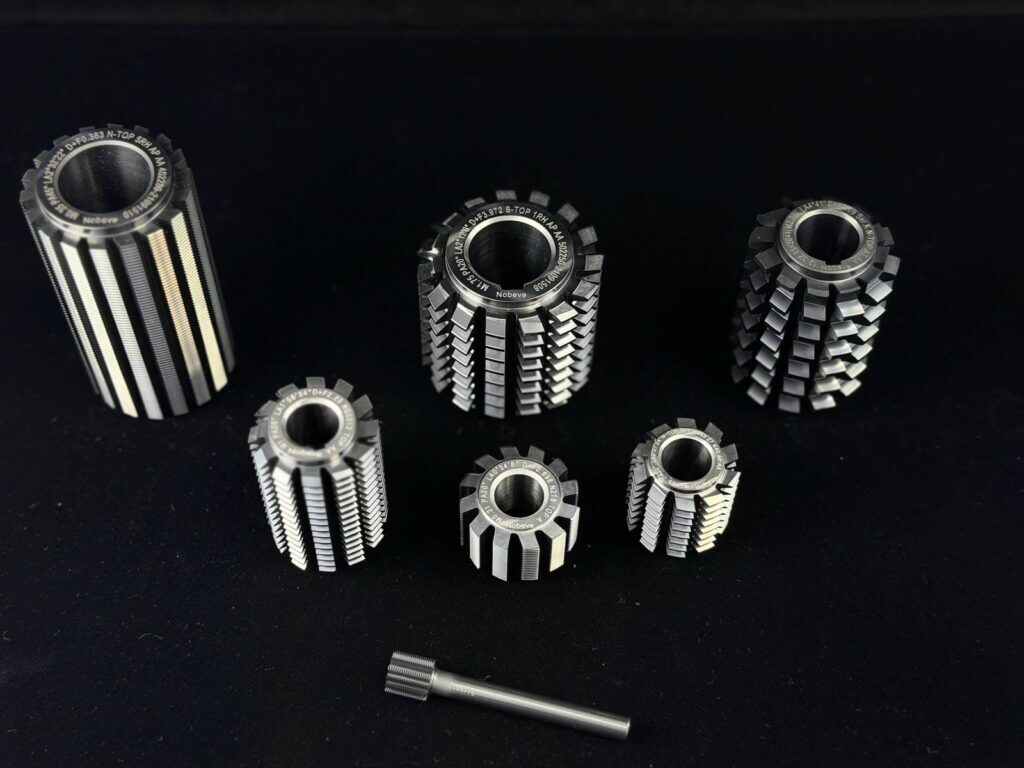
Because agricultural transmission gears undergo deep case carburizing and subsequent profile grinding, a standard hob profile produces an incorrect root geometry — the grinding wheel would contact the tooth root fillet, creating harmful stress risers. Nobeve's solution is the protuberance hob design: the hob tip is modified to pre-cut an undercut at the exact grinding stock depth (e.g., 0.15 mm), ensuring the post-hardening grinding wheel only contacts the active flank. This technique is mandatory for gear sets in high-speed CVT transmissions where fatigue life is a primary design criterion.
Custom Profile Hobs for PTO Splines
PTO spline shafts must conform to precise tolerance standards — DIN 5480 or equivalent SAE standards — to ensure vibration-free engagement with driven implements under shock loads. Off-the-shelf hobs often introduce profile errors that lead to poor fitment and field vibration. Nobeve manufactures custom profile hobs ground to the customer's exact spline standard, eliminating this source of drivetrain NVH at its root cause.
Tip Relief Integration
For gear teeth that must withstand heavy shock engagement — such as in tractor final drives encountering rocky terrain — Nobeve can integrate tip relief (chamfer) directly into the hob profile. This modification removes the sharp corner at the gear tooth tip during hobbing, preventing edge chipping when the gear engages under impact loads and extending drivetrain service life.
Frequently Asked Questions
| Q: Which Nobeve gear tool series is best for high-volume OEM tractor transmission gears?A: The K-Series High Speed Dry Cutting Hob is the primary recommendation. It supports dry cutting at up to 300 m/min with Balzers ALCRONA PRO coating, enabling the cycle times and cost-per-part economics that large-volume OEM production demands. The machine must have a spindle exceeding 2,000 RPM and dry-chip evacuation. |
| Q: Can Nobeve W-Series power skiving cutters machine carburized ring gears after heat treatment?A: Yes. The W-Series solid carbide skiving cutter is recommended for workpieces up to HRC 50. Hard power skiving actively removes material to correct pitch and runout errors introduced by heat-treatment distortion — a capability that is not feasible with P-Series PM-HSS cutters, which soften rapidly when cutting hardened steel. |
| Q: Why does Nobeve recommend the N-Series hob for aftermarket repair shops instead of carbide?A: Solid carbide hobs are hard but brittle. Older manual hobbing machines with spindle runout will cause carbide edges to chip or shatter. The N-Series uses a high-toughness sintered alloy that absorbs vibration rather than fracturing, delivering reliable tool life and significantly lower total tooling cost in low-volume, variable-condition repair environments. |
| Q: What is a protuberance hob and why is it required for agricultural OEM gears?A: A protuberance hob incorporates a modified tip profile that pre-cuts an undercut at the root of the gear tooth equal to the intended grinding stock (e.g., 0.15 mm). This ensures the post-hardening grinding wheel contacts only the active tooth flank, preventing grinding burn at the root fillet — a stress riser that would cause fatigue fracture under the heavy loads agricultural gears endure. |
| Q: Which gear tool series does Nobeve recommend for cutting 20CrMnTi forged gear blanks with rough forging skin?A: Forged blanks often have a hard, uneven skin that creates interrupted cutting conditions. For rigid CNC machines, the K-Series (before heat treatment) or G-Series (after heat treatment) is recommended. For older, lower-rigidity machines, the N-Series HSS-Co grade is strongly preferred due to its superior toughness, which allows it to cut through forging scale without chipping. |
| Q: Does Nobeve provide technical support for selecting the correct gear tool for my specific application?A: Yes. The Nobeve engineering team offers custom tool design, cutting parameter simulation, and selection guidance based on your gear drawing, machine specifications, and production volume. Visit nobeve-tool.com or contact the team directly to receive a tailored tool recommendation. |
Conclusion: The Right Gear Tool for Every Agricultural Challenge
Agricultural machinery represents one of the most demanding and diverse environments in gear manufacturing — simultaneously requiring the absolute highest throughput in OEM factories and the most forgiving, cost-conscious tools in global repair workshops. As this article's case studies demonstrate, no single gear tool can address every scenario. Nobeve Tool's product portfolio offers a graduated, scenario-matched solution:
- K-Series: Dry-cutting carbide hobs for high-volume OEM transmission and PTO shaft production on modern high-speed CNC hobbing machines.
- W-Series: Solid carbide power skiving cutters for hard skiving of carburized ring gears after heat treatment — replacing gear grinding and dramatically reducing finishing cycle times.
- P-Series: PM-HSS power skiving cutters for high-toughness soft-material skiving where edge stability under shock loads is the primary concern.
- N-Series: Toughness-first carbide hobs for aftermarket repair shops operating legacy hobbing machines, delivering reliable results under vibration-prone conditions at a favorable cost.
Whether you are engineering a next-generation CVT transmission or repairing a 40-year-old sugar-cane harvester gearbox, the correct gear tool is the one precisely matched to your machine, your material, and your production economics. Nobeve Tool — visit nobeve-tool.com to send your gear drawing and receive a free engineering recommendation from the Nobeve technical team.For more information on Nobeve's full product range, visit: K-Series Hobs | G-Series Hobs | N-Series Hobs | W-Series Skiving | P-Series Skiving