
You’ve invested in a precision grinding machine. Your gear tolerances are tight. But after grinding, you’re still seeing undercutting at the root, or the grinding wheel is clashing with an adjacent shoulder. Sound familiar?
This is one of the most frustrating — and expensive — problems in gear manufacturing. And more often than not, the root cause isn’t the grinder. It’s the hobbing stage that came before it.
When engineers specify a gear that will undergo post-hobbing grinding or shaving, the hob used for pre-machining must do more than just cut a gear. It must leave precisely the right amount of stock material — in precisely the right places — so the downstream finishing operation can do its job cleanly.
This guide breaks down how pre-grind and pre-shave gear hobs work, what protuberance and chamfer features actually do to protect your finishing operation, and how Nobeve engineers custom hob profiles to match your exact process requirements.
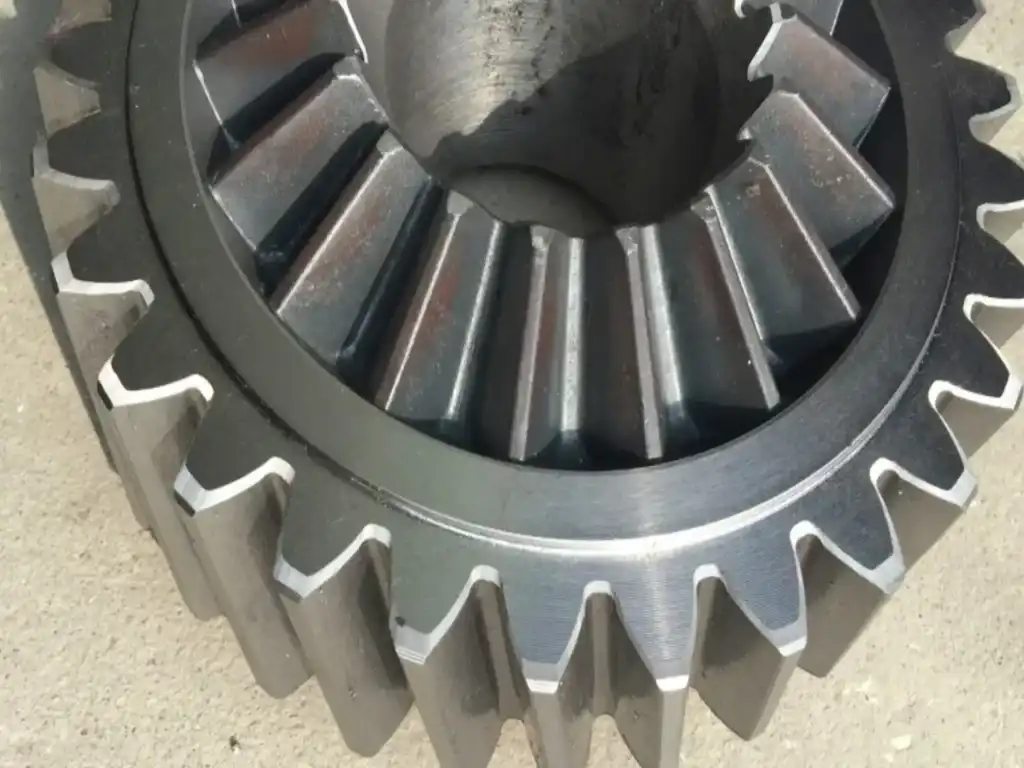
What Are Pre-Grind and Pre-Shave Gear Hobs?
Let’s start with the basics. A standard hobbing operation produces a gear that is already close to final geometry. But for high-precision gears — automotive transmissions, wind turbine gearboxes, aerospace actuators — hobbing alone is rarely sufficient. The gear will go through one or more finishing processes:
- Gear grinding: A grinding wheel follows the tooth flank profile, removing small amounts of material to achieve DIN 5 or better accuracy and Ra < 0.4 µm surface finish.
- Gear shaving: A shaving cutter meshes with the gear under a small cross-axis angle, burnishing and scraping the flanks to improve surface quality on softer (pre-heat-treat) gears.
A pre-grind hob is specifically designed to leave a defined amount of material (the “grinding stock” or “grinding allowance”) on the tooth flanks and root, and to incorporate protuberance and tip chamfer features that protect the geometry during grinding.
A pre-shave hob serves a similar function but is optimized for shaving as the finishing step — typically used on softer steels (≤ HRC 30) before heat treatment.
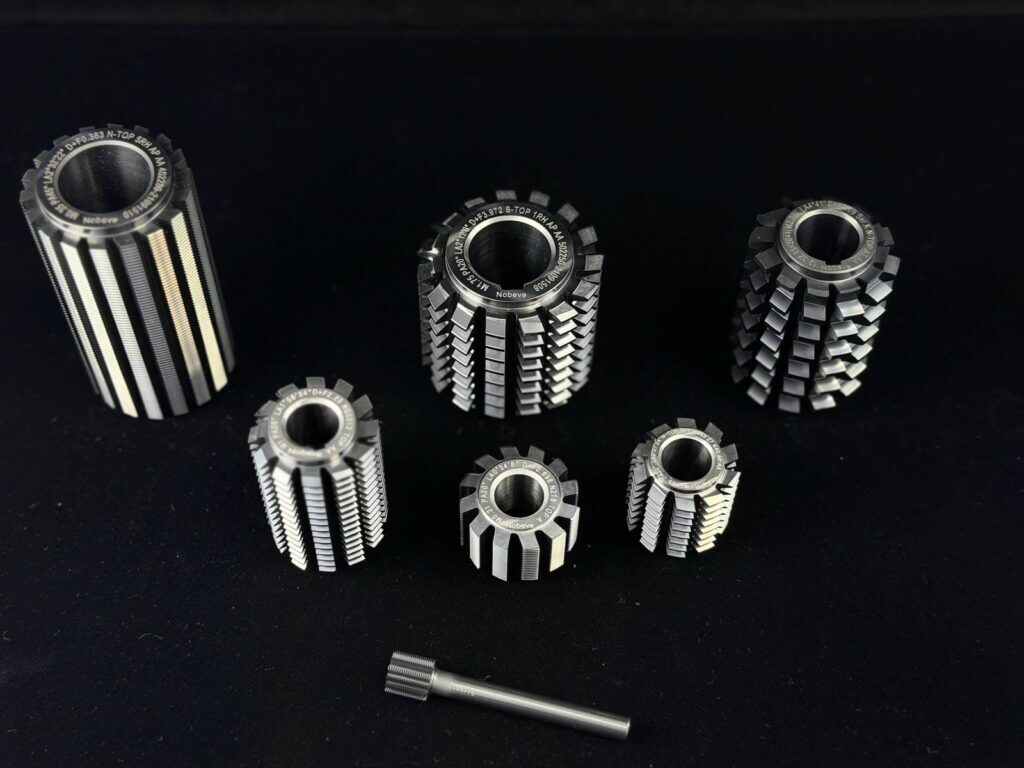
The distinction matters enormously for tool selection. Nobeve’s K-Series high-speed dry cutting hobs and G-Series hard-cutting hobs can both be configured with pre-grind profiles depending on your application.
How Much Grinding Stock Should You Leave?
This is where many engineers either over-specify or under-specify, both of which create problems.
| Parameter | Typical Range | Notes |
| Flank grinding stock (per side) | 0.10 – 0.25 mm | Depends on module and gear accuracy requirement |
| Root grinding stock | 0.05 – 0.15 mm | Must clear grinding wheel tip radius |
| Pre-shave stock (per side) | 0.04 – 0.10 mm | Shaving removes less than grinding |
| Tip chamfer height | 0.1 – 0.3 × module | Prevents grinding wheel corner interference |
Too little stock and the grinder can’t clean up all the hobbing marks — you get ghost lines and surface finish failures. Too much stock and grinding time increases dramatically, wheel wear accelerates, and the risk of thermal damage (grinding burn) rises.
Protuberance: The Hidden Feature That Protects Your Grinding Operation
Protuberance is a deliberate, engineered undercut built into the hob tooth profile in the region between the active flank and the root. When the hob cuts the gear, this protuberance creates a small step or groove at the tooth root — below the active involute profile.
Here’s why this matters so much in practice:
Why Protuberance Is Not Optional for Pre-Ground Gears
When a grinding wheel follows the tooth involute profile downward toward the root, it has a finite tip radius. Without protuberance, the grinding wheel tip will inevitably contact and modify the root fillet — the critical stress-bearing zone of the gear tooth.
This creates two serious problems:
- Root undercut: The grinding wheel removes material from the root fillet, reducing the root bending strength of the gear. This is a major structural integrity issue in power transmission applications.
- Grinding interference: The wheel tip can physically collide with the gear root geometry, causing wheel breakage or tooth damage — an expensive and potentially dangerous failure mode.
Protuberance eliminates both risks. The undercut created during hobbing provides the clearance space the grinding wheel tip needs to operate freely, without ever touching the root fillet.
The amount of protuberance required is a function of: the grinding wheel tip radius, the expected grinding stock on the flank, the gear module, and the pressure angle. This calculation is part of the engineering service Nobeve provides — contact us at nobeve-tool.com/contact-us/ with your gear drawing and we’ll work through the numbers with you.
Protuberance Profile Types: Full vs. Semi
| Type | Description | Best Used When |
| Full protuberance | Undercut runs the full depth of the non-involute root zone | Large grinding stock; aggressive grinding wheel geometry |
| Semi-protuberance | Partial undercut; transition is more gradual | Fine-pitch gears; moderate grinding stock; shaving operations |
| No protuberance (standard) | Standard DIN 3972 tooth form; no undercut | No grinding of root zone; shaving or rolling only |
Tip Chamfer: Protecting the Gear Tip and Grinding Wheel Corner
The tip chamfer (also called a tip relief or corner chamfer) is a second profile modification, this time at the tooth tip rather than the root. It serves a different but equally important purpose.
During hobbing, the hob cuts a small radius or chamfer at the gear tooth tip. This chamfer does three things:
- Prevents tip-to-root interference during grinding: The gear tip profile, if left sharp, can dig into the grinding wheel’s corner radius, causing wheel wear and profile errors.
- Reduces gear mesh noise: A small tip relief on the driving gear eases the entry into contact, reducing transmission error and acoustic noise.
- Simplifies deburring: A chamfered tip is inherently less likely to produce burrs that contaminate the grinding machine.
The tip chamfer geometry on the hob must be calculated to produce the correct chamfer on the gear — accounting for the helical motion of hobbing. This is not the same as simply specifying a chamfer angle on the gear drawing; the hob profile must be the kinematic inverse of the desired gear form.
Pre-Grind vs. Pre-Shave Hobs: Choosing the Right Approach
Before specifying your hob, answer three questions: What is the gear material hardness after heat treatment? What is the finishing process? And what accuracy class is required?
| Factor | Pre-Grind Hob | Pre-Shave Hob |
| Downstream process | Profile grinding | Gear shaving |
| Part hardness at finishing | HRC 55–62 (after heat treat) | ≤ HRC 30 (before heat treat) |
| Finishing stock (per side) | 0.10–0.25 mm | 0.04–0.10 mm |
| Protuberance required? | Yes — mandatory | Optional / semi-protuberance |
| Typical applications | Automotive gearboxes, aerospace, wind | Commercial vehicles, light industrial |
| Nobeve hob series | K-Series, G-Series (solid carbide) | N-Series, P-Series (PM-HSS/carbide) |
For soft-material, pre-shave applications, Nobeve’s P-Series PM-HSS power skiving tools and N-Series low-speed hobs offer the toughness and chip geometry optimized for leaving a precise, consistent shaving stock.
For hardened gears requiring grinding, the G-Series solid carbide hobs — capable of cutting materials from HRC 45 to HRC 62 — can be profiled with full protuberance and tip chamfer for pre-grind duty.
How Nobeve Engineers Custom Pre-Grind Hob Profiles for Your Process
Customizing a pre-grind hob profile is an engineering exercise, not just a catalog selection. Here is the process Nobeve follows when a customer sends us a gear drawing requiring pre-grind tooling:
Step 1 — Analyze the Gear Drawing and Process Specifications
We start by reviewing your DXF, DWG, or STEP file alongside your process sheet. Key data we extract:
- Module, pressure angle, helix angle, number of teeth
- Tooth accuracy class required (DIN 5 / AGMA 12 / ISO 3 or better)
- Grinding stock specified per flank and at root
- Grinding wheel tip radius and grinding machine kinematics
- Gear material and heat treatment sequence
Step 2 — Calculate the Modified Hob Tooth Profile
Using the grinding stock and wheel geometry data, our engineers calculate:
- Protuberance height (Δh): The additional root relief beyond the standard tooth depth. This is typically 0.10–0.30 mm depending on module.
- Protuberance width: The horizontal extent of the undercut, sized to fully clear the grinding wheel corner radius.
- Tip chamfer angle and length: Calculated from the desired gear tip chamfer dimensions using the inverse kinematic transformation for hobbing.
- Stock-leaving flank offset: A uniform outward shift of the active involute profile to leave the specified grinding stock.
Step 3 — Simulate and Verify
Before cutting a single hob, we simulate the hobbed gear tooth form to verify that:
- The protuberance creates sufficient clearance for the grinding wheel
- The stock left on the flanks is uniform across the tooth height
- The tip chamfer produces the correct gear geometry after hobbing
- No interference exists between the hob and gear at any phase of the hobbing cycle
Step 4 — Precision Grinding of the Hob Profile
The modified tooth profile is then ground into the hob with CNC profile grinding equipment. Nobeve’s hobs are coated with BALINIT® ALTENSA (Balzers) — a high-performance AlTiN-based coating that maintains cutting edge sharpness at the fine protuberance geometry, where edge integrity is most critical.
Learn more about Nobeve’s manufacturing standards and engineering capabilities on the About Nobeve page.
Industry Standards for Pre-Grind Hob Profiles
Pre-grind hob profiles are not arbitrary — they are governed by established standards. The primary reference is DIN 3972, which defines four standard tooth form profiles (I, II, III, IV) for hobbing. Profiles III and IV incorporate protuberance geometry specifically for pre-grind applications.
The American Gear Manufacturers Association (AGMA) provides parallel guidance in AGMA 1102 and AGMA 2001, which are widely referenced by U.S. manufacturers specifying pre-machining allowances.
For aerospace and defense applications, AS9100-certified gear manufacturers often add their own drawing callouts specifying the exact protuberance dimensions, which Nobeve can reproduce precisely from your engineering package.
Common Mistakes Engineers Make When Specifying Pre-Grind Hobs
After working with gear manufacturers across North America, Europe, and Asia, we see the same specification errors repeatedly:
Mistake 1: Specifying a Standard Hob for Pre-Grind Duty
A standard DIN 3972 Profile I hob produces a tooth with no protuberance. If you grind this gear, the wheel will intrude into the root fillet. The result is a weakened tooth or a grinding interference crash.
Mistake 2: Using the Same Hob for Pre-Grind and Finish Hobbing
Some shops try to run a pre-grind hob in finish-hob mode when grinding isn’t available. The protuberance undercut remains visible as a groove in the root, which is unacceptable cosmetically and can be a stress concentrator.
Mistake 3: Ignoring the Effect of Gear Geometry on Protuberance Size
Protuberance is not a one-size-fits-all dimension. A module 2 gear and a module 6 gear with the same nominal grinding stock require significantly different protuberance geometries. Always provide the complete gear data — not just the grinding stock number.
Frequently Asked Questions
What file formats does Nobeve accept for custom hob engineering?
We accept DXF, DWG, STEP, and IGES formats, as well as PDF gear drawings with a full data block. Our engineers will confirm receipt and provide a preliminary feasibility response within 24–48 business hours.
Can you match an existing hob profile from another supplier?
Yes. If you have a worn or discontinued hob you need to replicate — including one with a proprietary protuberance geometry — we can reverse-engineer the profile from your sample or from a detailed measured profile report. Contact us with your requirements.
What lead time should I expect for a custom pre-grind hob?
Lead times vary by hob size and complexity. Standard modules with modified profiles typically require 4–6 weeks. Very large or complex profiles may require 8–10 weeks. We recommend contacting Nobeve early in your project timeline to avoid process delays.
What accuracy class do Nobeve’s pre-grind hobs achieve?
Nobeve’s K-Series and G-Series hobs are manufactured to DIN AA and DIN AAA accuracy. This ensures that the protuberance and tip chamfer geometry are ground with sufficient precision that they do not introduce error into the gear tooth form beyond the grinding stock allowance.
Is pre-grind hobbing suitable for helical gears?
Yes — and the calculation is more complex. The helix angle affects the apparent protuberance as seen in the normal plane. Nobeve’s engineers account for this transformation when designing hobs for helical pre-grind applications. Provide your helix angle, hand of helix, and normal module in your drawing package.
Get the Pre-Machining Right — and Grinding Becomes Easy
Pre-grind and pre-shave gear hobs are not simply “standard hobs with less material removed.” They are precision-engineered tools where protuberance geometry, tip chamfer design, and grinding stock allocation must be calculated to match your specific downstream process.
Get this right, and your grinder runs cleanly, your gear geometry is protected, and your process is stable. Get it wrong, and you’re dealing with root damage, grinding interference, or scrapped parts that passed the hobbing stage but failed at final inspection.
Nobeve specializes in exactly this kind of engineering-driven tool customization. Visit nobeve-tool.com to explore our full product range, or send your gear drawing directly to our engineering team for a free evaluation.
| **Free Engineering Evaluation** Send your DXF, DWG, or STEP gear drawing to Nobeve for a no-obligation engineering review. Our team will: *Calculate the correct protuberance and tip chamfer for your grinding/shaving process *Recommend the appropriate Nobeve hob series and coating *Provide a detailed technical proposal with lead time and pricing **Submit your drawings at: nobeve-tool.com/contact-us/ |

