Introduction: Why Power Skiving Tools Are Reshaping Gear Manufacturing
As gear manufacturing evolves toward tighter tolerances, smaller batch sizes, and complex internal geometries, power skiving tools have emerged as the defining technology of the decade. Unlike traditional hobbing or shaping, power skiving enables continuous, high-speed cutting of internal and external gears on a single machine — dramatically reducing cycle times and setup overhead.
In this complete application guide, Nobeve’s engineering team walks through everything you need to know about deploying power skiving tools effectively: from understanding the skiving kinematics and selecting the right cutter geometry, to matching tool material to workpiece hardness and diagnosing common wear patterns. Whether you operate a dedicated skiving center or a mill-turn machine, this resource will help you get the most from your investment.
For an authoritative technical foundation, the AGMA (American Gear Manufacturers Association) publishes gear accuracy and process standards that complement the application guidance below.
What Is Power Skiving? A Technical Overview
The Skiving Kinematics
Power skiving is a continuous generating process in which the skiving cutter and workpiece rotate on crossed axes — typically at a crossing angle (Σ) between 15° and 30°. The relative motion between the two axes creates the cutting action, enabling chip removal at every rotation cycle without the indexing pauses that limit conventional gear shaping.
The axial feed of the cutter along the workpiece axis, combined with the synchronized rotational speeds, produces a helical generating motion. This makes power skiving ideal for both spur and helical gears, including internal ring gears that are difficult or impossible to hob.
Key Process Parameters
- Crossing angle (Σ): Typically 15°–30°; larger angles increase cutting velocity but also axial force
- Cutting speed (Vc): Depends on tool material — carbide tools support 120–300 m/min; PM-HSS tools run at 60–150 m/min
- Axial feed per revolution: 0.2–0.5 mm/r for carbide; 0.2–0.4 mm/r for PM-HSS
- Number of passes: Rough skiving (1–2 passes) followed by finish skiving (1 pass) is standard practice
- Coolant: High-pressure flood oil cooling is essential for both tool types
Machine Requirements for Power Skiving
Power skiving places demanding requirements on machine tool stiffness, axis synchronization accuracy, and spindle rigidity. The best results are achieved on dedicated skiving machines or advanced mill-turn centers with:
- Spindle synchronization error below 0.002° to maintain DIN AA gear accuracy
- High spindle rigidity — especially critical for carbide (W-Series) tools, which are sensitive to vibration-induced chipping
- Rotational speed capability of at least 2000 rpm on the tool spindle for efficient carbide cutting
- Oil cooling delivery with sufficient flow rate and pressure to evacuate chips and control thermal expansion
Choosing the Right Power Skiving Tool: W-Series vs. P-Series
Nobeve manufactures two primary families of power skiving tools: the W-Series (Cemented Carbide) and the P-Series (Powder Metallurgy High-Speed Steel). Understanding when to deploy each is critical to achieving optimal tool life, surface finish, and production efficiency.
W-Series Carbide Skiving Cutters
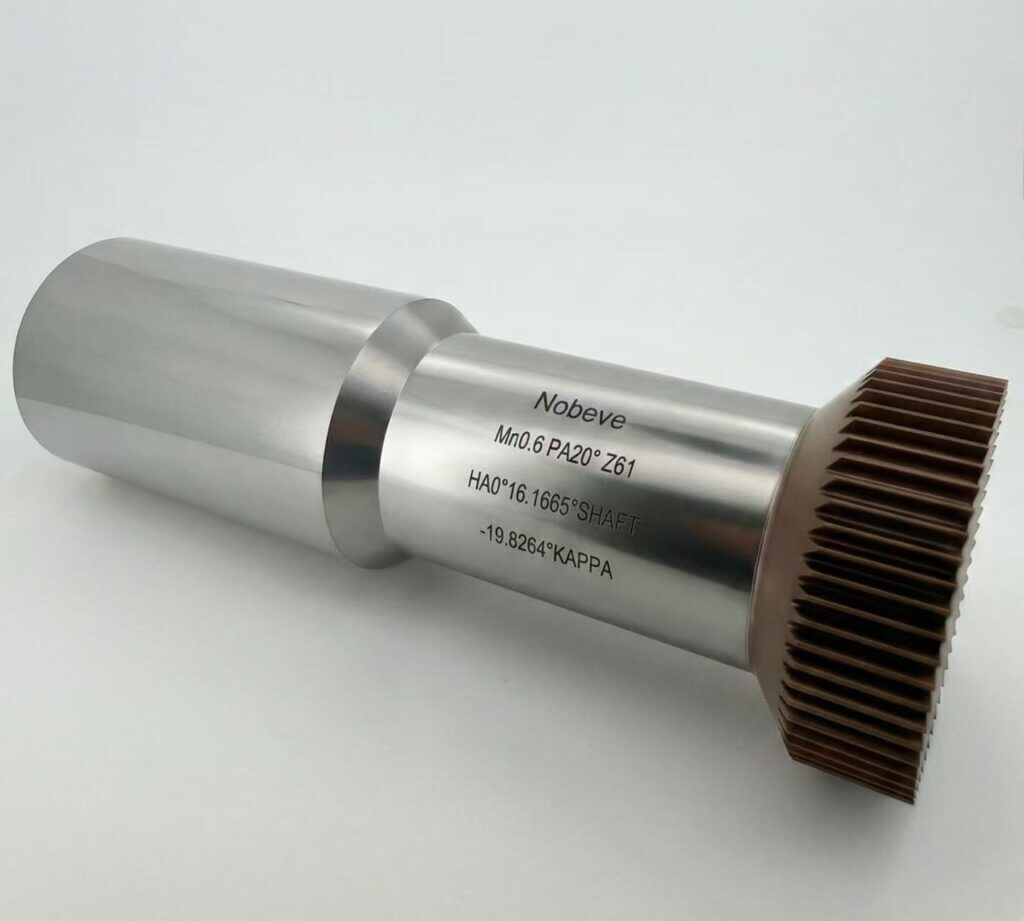
The W-Series carbide power skiving cutter is manufactured from a cold-pressed, sintered tungsten-cobalt (WC-Co) alloy substrate and coated with BALINIT® ALTENSA from Oerlikon Balzers. It is the primary choice for:
- Hard workpieces: materials up to HRC 50° (case-hardened steel, nitrided steel)
- High-speed production: cutting speeds up to 300 m/min maximize throughput on modern CNC skiving machines
- Small-angle cylindrical skiving: the carbide substrate enables precise cutting at low crossing angles without deflection
- High-volume automotive applications: reduced wear rate lowers cost-per-gear at scale
Key limitation: carbide is brittle. If machine spindle rigidity is insufficient or workpiece fixturing introduces vibration, tooth chipping becomes a significant risk. The W-Series demands a stable, high-rigidity spindle and well-balanced workholding.
P-Series PM-HSS Skiving Cutters
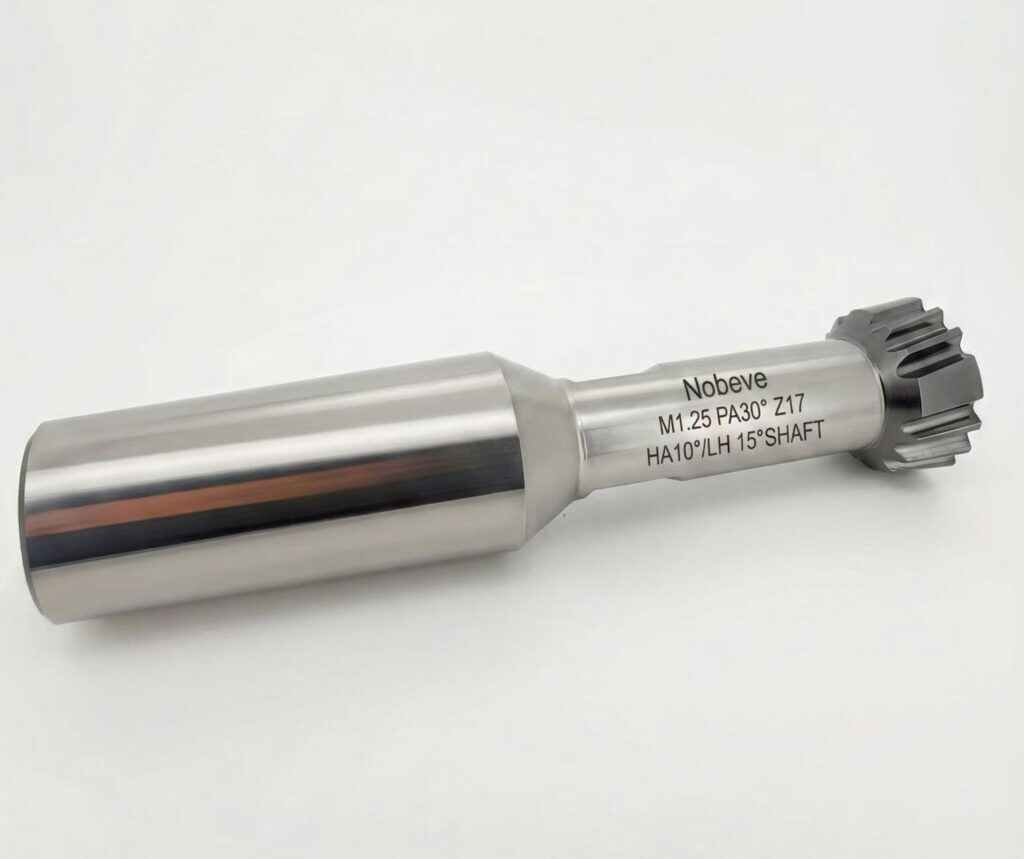
The P-Series PM-HSS power skiving cutter uses solid rod substrate from Austrian manufacturer BÖHLER — a premium powder metallurgy high-speed steel that occupies the performance space between conventional HSS and cemented carbide. The P-Series is the preferred choice when:
- Workpiece material is soft or high-toughness (≤HRC 30°): PM-HSS absorbs micro-shocks without chipping
- Machine rigidity is limited: older or less rigid skiving machines tolerate the greater toughness of PM-HSS far better
- Interrupted cutting or variable engagement: the conical geometry recommended for P-Series distributes cutting loads more evenly
- Anti-chipping is the top priority: the conical P-Series design dramatically reduces edge breakage probability on tough, fibrous steels
Both the W-Series and P-Series achieve DIN AA precision and are coated with BALINIT® ALTENSA for maximum surface hardness and reduced friction coefficient — ensuring that even the PM-HSS substrate delivers exceptional tool life.
Head-to-Head Comparison Table
| Criteria | W-Series (Carbide) | P-Series (PM-HSS) | Recommendation |
| Workpiece Hardness | Up to HRC 50° | Up to HRC 30° | Hard: W-Series; Soft: P-Series |
| Cutting Speed (Vc) | 120–300 m/min | 60–150 m/min | High-speed: W-Series |
| Toughness / Anti-Chip | Moderate — needs rigid spindle | Excellent — resists chipping | Interrupted cut: P-Series |
| Coolant | Oil cooling required | Oil cooling required | Both require flood oil |
| Machine Requirement | High spindle rigidity | Flexible — tolerates vibration | Old/flexible machines: P-Series |
| Feed Rate | 0.2–0.5 mm/r | 0.2–0.4 mm/r | Similar range |
| Coating | BALINIT® ALTENSA | BALINIT® ALTENSA | Identical premium coating |
| Precision Grade | DIN AA | DIN AA | Equal precision |
Material Compatibility and Workpiece Selection
Steels and Case-Hardened Alloys
For case-hardened alloy steels (16MnCr5, 20MnCr5, 18CrNiMo7-6) commonly used in automotive transmission gears:
- Pre-hardened state (≤HRC 30°): P-Series PM-HSS is the preferred option — higher toughness prevents chipping on the interrupted entry cut
- Post-hardening (HRC 45°–50°): W-Series carbide with ALTENSA coating enables hard skiving in a single setup, eliminating the separate grinding operation
- HRC 50°–55°: Use G-Series hard-cutting hobs in combination with finish skiving for ring gear geometries
Nitrided and High-Alloy Steels
Nitrided steels and high-alloy tool steels present elevated abrasion. The BALINIT® ALTENSA coating on both W-Series and P-Series tools provides the aluminum-chromium-nitride (AlCrN) layer that resists abrasive wear up to 1100°C, making it the coating of choice for these demanding applications.
Low-Carbon and High-Toughness Materials
For gear blanks made from low-carbon or microalloyed steels, the P-Series consistently outperforms carbide tools in edge durability. The combination of BÖHLER PM-HSS substrate and the conical cutter geometry creates a robust cutting edge that maintains sharpness through long runs of soft, sticky material.
Application Best Practices for Power Skiving Tools
Setup and Runout Control
Runout is the single largest source of premature power skiving tool wear. Before the first cut:
- Verify tool arbor runout is below 0.003 mm TIR at the cutting face
- Check workpiece fixture concentricity — a wobbling blank induces radial force spikes that chip carbide cutters
- Pre-warm the machine spindle for 10–15 minutes to reach thermal equilibrium before taking finish passes
Cutting Strategy: Roughing and Finishing
A two-pass strategy extends tool life significantly:
- Roughing pass: remove 80–90% of stock at maximum feed (up to 0.5 mm/r for W-Series); this pass is hardest on the tool edge
- Finishing pass: reduce feed to 0.2 mm/r and increase spindle speed to target surface finish; the carbide edge shines at this stage
- For PM-HSS (P-Series): use a consistent feed of 0.2–0.3 mm/r throughout to prevent micro-chipping on the rake face
Coolant and Chip Evacuation
- Always use flood oil cooling — both W-Series and P-Series require oil (not water-based emulsion) for skiving
- Direct coolant nozzles at the cutting zone and chip exit channel simultaneously
- Clean the tool and arbor bore thoroughly between re-grinds to prevent coolant residue from altering the thermal balance
Tool Life Monitoring and Re-Grinding
Nobeve recommends monitoring flank wear land (VB) at each tool face. For W-Series, change or regrind when VB exceeds 0.10 mm; for P-Series, the limit is 0.15 mm. Both tool families support multiple regrinding cycles — see Nobeve’s technical support page for regrinding tolerances and resharpening services.
Selecting the Right Nobeve Series: A Decision Framework
Use this quick decision framework to choose between Nobeve’s power skiving tool families:
- What is the workpiece hardness? — If >HRC 30°, go W-Series. If ≤HRC 30°, continue to step 2.
- Does your machine achieve >2000 rpm spindle speed with high rigidity? — If yes, W-Series is also viable for soft materials. If no, choose P-Series.
- Is interrupted cutting or variable engagement a concern? — If yes, always choose P-Series to avoid chipping.
- Is maximum throughput (Vc > 150 m/min) required? — If yes, W-Series is the only option.
For hob-type gear machining applications, explore Nobeve’s complementary product families: the K-Series dry-cutting hobs for high-speed dry hobbing, the G-Series hard-cutting hobs for hardened gear blanks, and the N-Series soft-cutting hobs for legacy machines and soft steel production.
Frequently Asked Questions
Q: What is the difference between power skiving and gear shaping?
A: Gear shaping uses a reciprocating cutting motion (back-and-forth) and must index between strokes, limiting speed. Power skiving uses a continuous rotational cutting motion on crossed axes, achieving much higher material removal rates — typically 3–5x faster — and is better suited to modern CNC skiving machines and mill-turn centers.
Q: Can power skiving tools machine internal ring gears?
A: Yes — this is one of the primary advantages of power skiving. Internal ring gears, which cannot be hobbed, are ideal candidates for skiving. Both the W-Series (carbide) and P-Series (PM-HSS) from Nobeve are available in designs optimized for internal gear skiving, including conical cutter geometries that improve chip clearance inside the bore.
Q: How do I know when to re-grind my power skiving cutter?
A: Monitor the flank wear land (VB) on each cutting face under magnification after each production run. Nobeve recommends re-grinding W-Series carbide cutters when VB reaches 0.10 mm, and P-Series PM-HSS cutters at 0.15 mm. Do not wait for visible chipping — by that stage, adjacent teeth may already be damaged. Both series support multiple regrind cycles when resharpened within the prescribed tolerance.
Q: Why does the P-Series use a conical rather than cylindrical geometry?
A: Conical power skiving cutters distribute cutting load more evenly along the tooth flank, reducing peak stress at any single point on the edge. For PM-HSS material, this geometry significantly lowers the probability of micro-chipping when cutting soft, high-toughness steels. Cylindrical geometry is recommended for the W-Series carbide cutter, particularly for small-angle cutting applications where radial stiffness is paramount.
Q: Does Nobeve offer custom power skiving tools for non-standard modules?
A: Yes. Nobeve manufactures custom power skiving tools to customer-specified module, pressure angle, helix angle, and tip diameter. Contact the engineering team via nobeve-tool.com with your gear data sheet for a quotation and lead time estimate.
Conclusion: Maximizing Productivity with the Right Power Skiving Tools
Power skiving has fundamentally changed what is achievable in precision gear manufacturing — offering the speed of hobbing, the versatility of shaping, and the accuracy of grinding, all in a single continuous process. Selecting the right power skiving tools is the key variable between marginal results and consistently excellent gears.
Nobeve’s W-Series and P-Series power skiving tools bring together the finest substrate materials (Konrad Friedrichs and BÖHLER), premium BALINIT® ALTENSA coatings, and decades of gear cutting expertise to deliver DIN AA precision across your full production range. Whether you’re machining hard case-hardened transmission gears at 250 m/min or cutting high-toughness ring gear blanks on a legacy skiving machine, there is a Nobeve cutter designed for your application.Visit nobeve-tool.com to explore our complete range of power skiving tools, request a technical consultation, or download detailed application data sheets. Our engineering team is ready to support your gear cutting process from first cut to final inspection.

